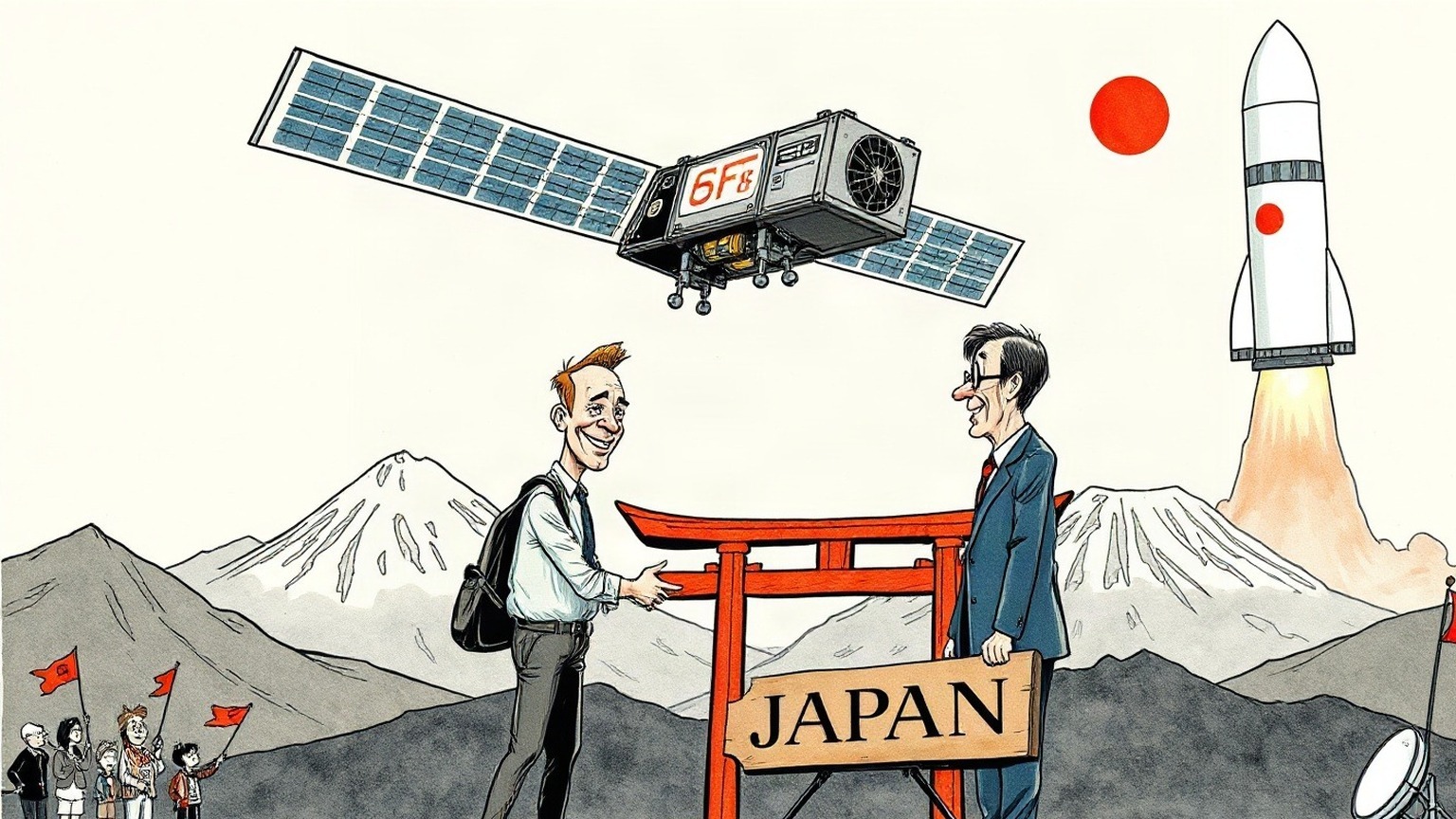
Nothing moves an early-stage space stock quite like the promise of sovereign cash. When headlines hit that Japan’s government was pumping up to $1 billion into a satellite communications joint venture with AST SpaceMobile and Rakuten, the market celebrated with a double-digit rally. Investors assumed Tokyo was underwriting the heavens. But if you read past the press releases and into the securities filings, the picture flips: Japan is not bailing out AST SpaceMobile. AST SpaceMobile is helping finance Japan.
Strip away the aerospace vocabulary, and AST SpaceMobile’s core business is surprisingly intuitive. The company builds flat satellites with unfolding antenna arrays as large as tennis courts. These orbital towers beam cellular signals directly to the ordinary, unmodified smartphone in your pocket—no dish, no special hardware, no dongles. Think of the company as an orbital landlord leasing antenna space to carriers whose land-based towers hit a geographic dead end.
Yet rolling that infrastructure out overseas, the economics resemble a car dealership co-signing your loan just to get the vehicle off the lot. The newly formed Tokyo venture, Rakuten AST, won selection under Japan’s low-Earth orbit program, qualifying for up to 148 billion yen (roughly $938 million) in government support. In exchange, AST SpaceMobile secures a $75 million one-time software license fee and satellite supply orders. The catch sits squarely in the fine print: AST SpaceMobile has agreed to subscribe for approximately $1.4 billion in no-coupon preferred shares over three years to fund everything the state grant fails to cover. Japan pays a substantial minority of the tab, but the vendor funds the lion’s share.
| Price LIVE | $36.89 |
| Market Cap | $13.1B |
| Forward P/E | n/a (unprofitable) |
| Total Revenue (TTM) | $142.9M |
| 52-Week Low | $27.58 |
| 52-Week High | $133.86 |
| Analyst Consensus | Hold (12 analysts) |
| Analyst Target Mean | $74.68 |
Why would a sovereign ministry sign up for this arrangement? Look at the changing architecture of artificial intelligence. As frontier models migrate from centralized data centers onto handheld devices, ambient agents and edge inference require constant, uninterrupted connectivity.
A dropped signal during a voice prompt is annoying. A dropped signal during autonomous driving or background financial execution is fatal. Governments now treat direct-to-device satellite arrays as non-negotiable national redundancy. Tokyo is buying an orbital safety net for its digital economy.
The urgency makes sense, but AST SpaceMobile’s balance sheet remains precarious. Third-quarter revenue rose to $42.3 million, short of Wall Street targets, while operating expenses swelled to $211 million. Capital expenditures topped $1.1 billion across the first nine months of the year, driven by satellite manufacturing. Cash and equivalents stood at $3.2 billion at quarter-end against more than $4 billion of long-term debt. Absorbing a fresh $1.4 billion commitment in Tokyo will test a company already burning cash at an industrial pace.
The bear case is straightforward and ruthless: AST SpaceMobile is funding its own order book while sitting beneath a mountain of leverage. The heralded Japanese grant is capped, not guaranteed, and not a single yen has landed in the corporate bank account yet. To stay alive this long, the company has quadrupled its Class A share count since 2022 and run total debt from $12.8 million to over $4.1 billion. It leaned heavily on convertible debt and dilutive equity comp.
Meanwhile, constellation milestones keep sliding. The target of 45 BlueBirds in orbit has shifted from late 2026 to mid-2027. One satellite was lost on a partner launch earlier this year, and management now plans to build its own reusable rocket, dubbed Blacklift. To top it off, SpaceX recently acquired nationwide mid-band spectrum for $17 billion and secured approval for a 15,000-satellite direct-to-device constellation. Starlink has 13.6 million consumer subscribers. AST SpaceMobile has twelve operational commercial satellites.
The company must prove this sovereign playbook is repeatable without gutting common shareholders. Shares trade around 90 times trailing sales and sit roughly 70% below their May peak, and the market is pricing AST SpaceMobile as a perpetual dilution machine. A re-rating requires management to turn a pipeline of roughly $1 billion in quasi-governmental funding into real prepayments that fund factory lines.
What to watch next is operational cadence: AST SpaceMobile needs roughly 45 satellites in orbit by mid-2027 to make coverage continuous. If the hardware reaches low-Earth orbit on schedule, sovereign contracts will follow. If launch timelines slip again, vendor financing will consume the cash that remains.
Disclosure: The Signal holds no position in ASTS. Positions may change. This is not financial advice.