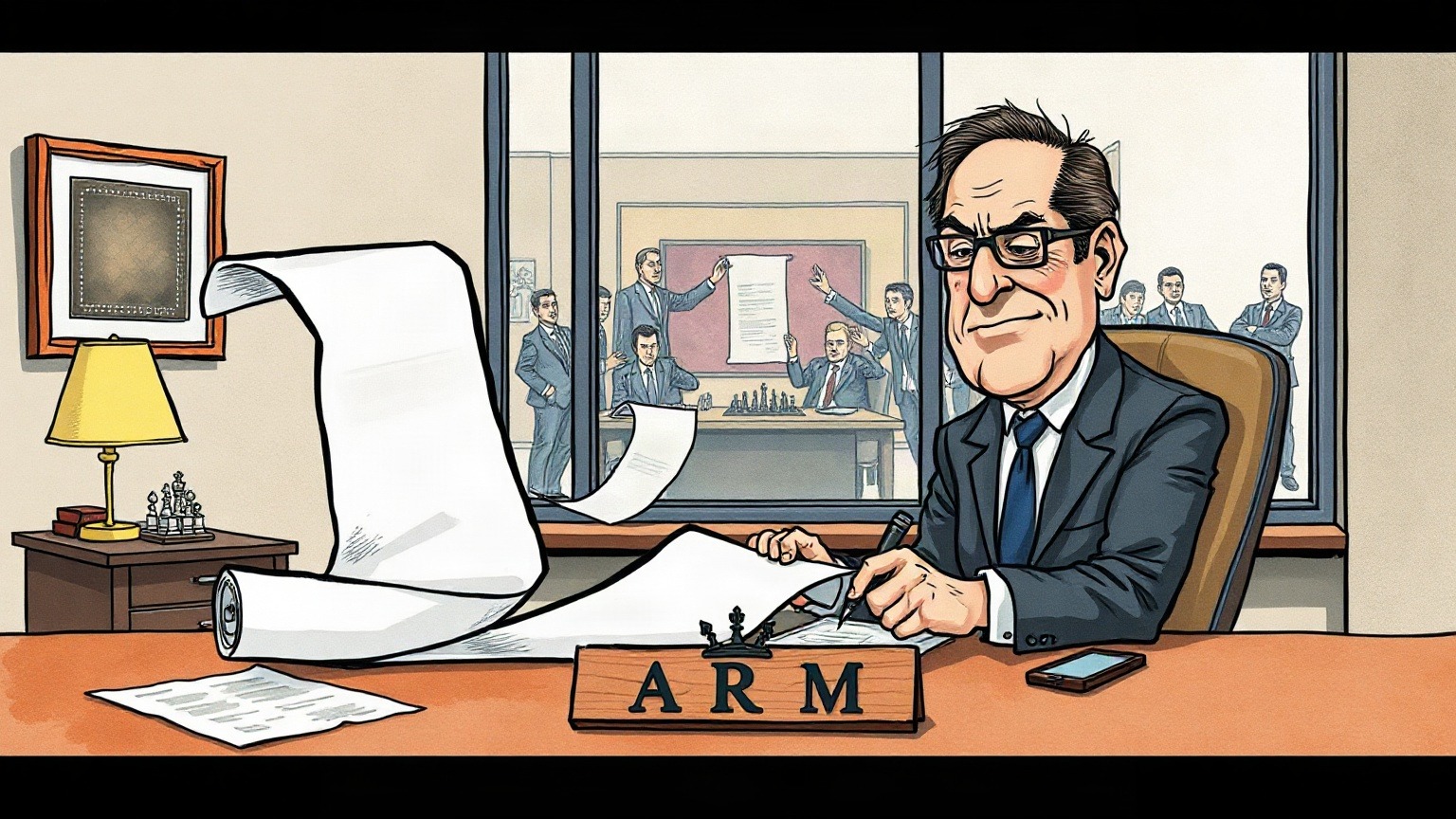
Two boards removed their leadership overhang in one morning. Nvidia reinstated Jensen Huang after an abrupt departure. Arm, which licenses the chip blueprints inside most of the world's phones, locked down chief executive Rene Haas through 2033 — after being formally approached about the Nvidia search. He chose to stay put. The decision anchors the company's management as the semiconductor landscape undergoes upheaval.
The drama Haas walked away from was extraordinary. Huang resigned after disclosures of extramarital relationships, prompting Nvidia to hire the search firm Heidrick & Struggles, where partner Jeff Sanders ran the search that put Haas near the top of the list. Then Nvidia's board reversed course. Huang was reinstated after government feedback, and the search ended.
Haas knows Nvidia intimately, from seven years there in which he rose to run its computing products business. He joined Arm in 2013, took over as chief executive in 2022, and led its public listing. Turning down outside overtures keeps the 64-year-old executive in place until he turns 71, and Arm disclosed no financial terms for the extension.
| Price LIVE | $152.20 |
| Market Cap | $162.9B |
| Forward P/E | 49.3x |
| Total Revenue (TTM) | $5.46B |
| 52-Week Low | $100.02 |
| 52-Week High | $452.70 |
| Analyst Consensus | Buy (40 analysts) |
| Analyst Target Mean | $272.43 |
To understand why Arm fought to keep him, consider how it actually operates. Arm does not manufacture wafers, run foundries, or sell physical microchips. Think of the company as the master architect of the technology sector. It licenses digital blueprints to other firms and collects a royalty fee on every chip shipped.
Because Arm sells intellectual property rather than physical hardware, gross margin sits comfortably above 97%. That architecture forms the invisible foundation under our modern digital lives. Roughly 99% of global smartphones run on Arm designs, which means the apps on your phone are drawing on this company's blueprints. Now, that same architecture is taking over artificial intelligence data centers.
Power efficiency is the ultimate bottleneck in modern computing clusters, which is why hyperscalers like Amazon and Microsoft have shifted their custom server silicon to Arm architecture. Arm's share of top cloud processors surged from roughly 15% in 2024 to over 50% in 2025. Management expects that cloud server footprint to surpass 60% before calendar 2026 ends.
Wall Street greeted the retention news warmly, sending Arm shares up roughly 17% in midday trading. That sharp pop needs honest perspective. Nvidia surged roughly 33% across the same session, dragging the whole semiconductor index with it. Arm simply caught the tide. Shares still sit roughly 60% below their June peak.
Arm's underlying business is expanding, but the mix reveals friction. Total second-quarter revenue grew 27% year over year to $1.443 billion, while annual contract value hit $1.79 billion. Yet durable royalty revenue rose just 8% to $670 million as memory inflation pinched smartphone demand. Licensing carried the quarter by jumping 50% to $773 million, heavily aided by $209 million from parent company SoftBank.
What has to happen for the equity to re-rate from roughly 58 times forward earnings is a complete business model pivot. Arm is moving beyond licensing blueprints to sell its own in-house AGI processors. Management raised its revenue target for that silicon effort to up to $2 billion across fiscal 2027 and 2028. After a punishing drawdown, the market is pricing deep skepticism rather than that ultimate ambition.
A dedicated short-seller would argue that market skepticism is entirely justified. SoftBank owns 86.4% of Arm, with roughly 72% of the entire company pledged against margin loans. Selling proprietary AGI silicon also puts Arm in direct competition with the licensees paying its bills. If royalty growth lingers in single digits while GAAP profits tumble, the multiple compresses from here. That is the entire bet.
Haas will also assume the role of vice chairman at SoftBank effective in December. That promotion formalizes an executive split investors were already watching closely, since he has run SoftBank Group International since April while also steering Arm. Two jobs, one calendar.
What we are watching is the fourth quarter of fiscal 2027. That milestone is the scheduled commercial debut for Arm's first in-house silicon shipments. Proving that Arm can deliver physical hardware without alienating key customers is essential to defending a multiple above 200 times trailing GAAP earnings. The market received executive continuity, but it still demands the product.
Disclosure: The Signal holds no position in ARM. Positions may change. This is not financial advice.