One corner of the phone market is still growing: foldables. Apple is about to walk into it with the most expensive iPhone it has ever made.
| AAPL Price | $319.97 |
| Market Cap | $4.67T |
| Forward P/E | 33.4 |
| Total Revenue (TTM) | $466.8B |
| 52-Week Low | $225.95 |
| 52-Week High | $344.57 |
| Analyst Consensus | Buy |
| Analyst Target Mean | $323.86 |
Quick primer, if you've only met Apple through headlines. It sells the iPhone, the Mac, the Watch, and services that keep hundreds of millions paying monthly. More than two billion Apple devices are in active use. The whole model runs on those people buying the next one.
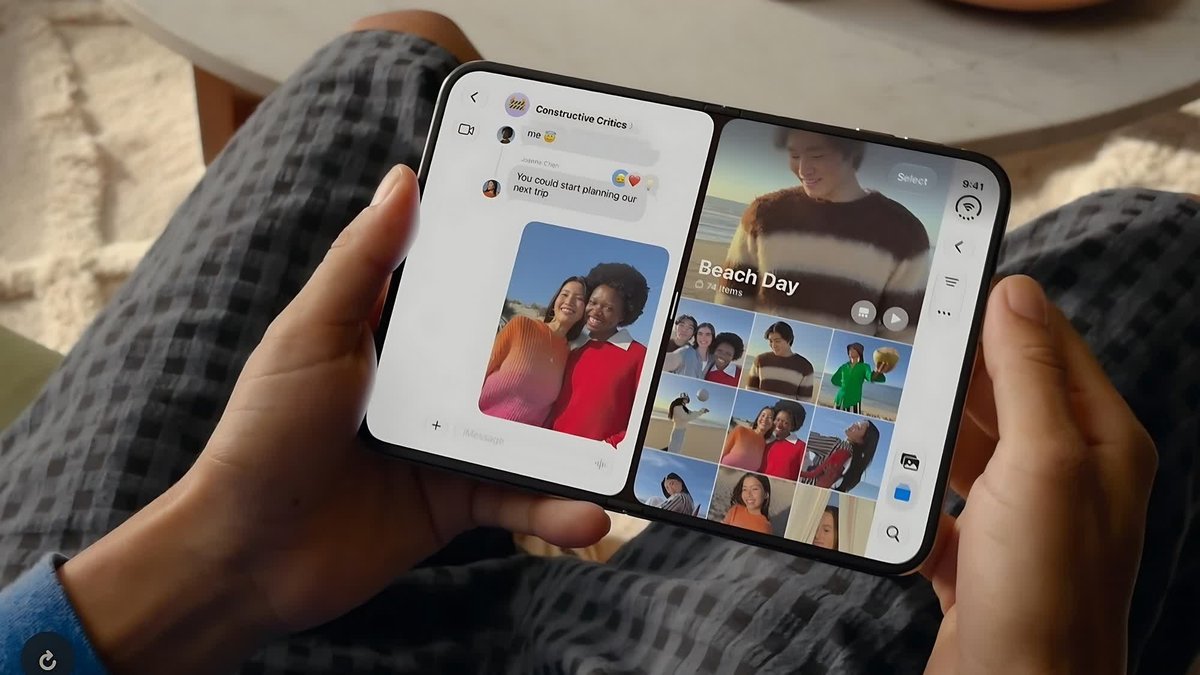
On September 9, at the Steve Jobs Theater, Apple is expected to unveil its first foldable — reportedly called 'iPhone Ultra' and priced above $2,000. Invites called the show 'Surprise and shine' — a fitting slogan for a debut. It would be John Ternus's first major keynote. He became CEO on September 1, when Tim Cook moved up to executive chairman.
Lately, that model has been sputtering. IDC expects the smartphone market to shrink about 16.7% in 2026 — a record contraction — as memory costs push prices up and people hold phones longer. Foldables are the one bright spot. The firm sees that niche growing 12.6% this year and 18% in 2027.
Here's the twist: Apple's arrival is a big reason that niche grows at all. Without Apple, IDC figures, foldables would shrink by double digits this year. Analysts expect Apple to ship more than 10 million foldables in year one and 17 million-plus by 2027 — roughly 40% of the global foldable market. By 2029, foldables should top 10% of the market's dollar value.
Samsung built this category, so it knows exactly what Apple's arrival means. Its share is projected to slip from about 40% to 32% as rivals pile in. Its Galaxy Z Fold 8 starts at $1,899, and a tri-fold is already on shelves. Samsung itself says Apple's entry helps the category.
For Apple, the prize is the upgrade cycle. People hold phones for years now, and a foldable is the rebuttal — a genuinely new shape at the very top of the market, where the profits live. Cook has argued that an 'upscale foldable' earns its place when customers will spend around $2,000 on a phone.
Now the part that makes this an AI story, not a gadget story. Two billion devices make Apple the biggest on-device AI distribution channel on earth. Siri AI — the LLM-based assistant first teased at WWDC in June — is expected to get its full launch at this event. A foldable's reported 7.8-inch screen gives that AI room to work.
iPhone 18 Pro models are expected too, with the standard iPhone 18 waiting until spring 2027. New Watches, AirPods 5, and the full Siri AI launch round out the stage.
But the foldable is the headliner — it carries the company's real argument that AI should finally sell hardware. So far, smarter software hasn't moved the upgrade needle. A new shape might.
There's a catch, though — the same one stalking the whole AI buildout. Memory prices are spiking as data centers vacuum up DRAM — the very story behind The Signal's Micron coverage. Apple isn't immune.
Cook called memory pricing a 'hundred-year flood' on Apple's last earnings call, with 'very significant' supply constraints. Apple already raised Mac and iPad prices in June, and a MacBook Air now starts at $1,299, up from $1,099. The iPhone got a pass — for now.
That's the quiet logic of the $2,000-plus price tag. A phone that expensive carries enough margin to absorb a memory spike that would gut a cheaper model.
The same dynamics that made DRAM the AI trade's hottest commodity now run straight through Apple's cost structure. Expensive isn't the problem here. It's the strategy.
For Ternus, the stakes are personal. He's a hardware engineer by training, and his opening move is a bet on form factor. BofA's take: Ternus 'could cement Apple's device dominance in an AI-enabled era,' and a foldable that sells at $2,000-plus while the market shrinks would prove it.
None of this is certain. The foldable is expected, not announced, and that price will make even loyalists blink. Watch what the event is really testing: whether AI, wrapped in a new shape, can restart the upgrade cycle. Apple is betting it can.
Disclosure: The Signal holds no position in AAPL. Positions may change. This is not financial advice.