
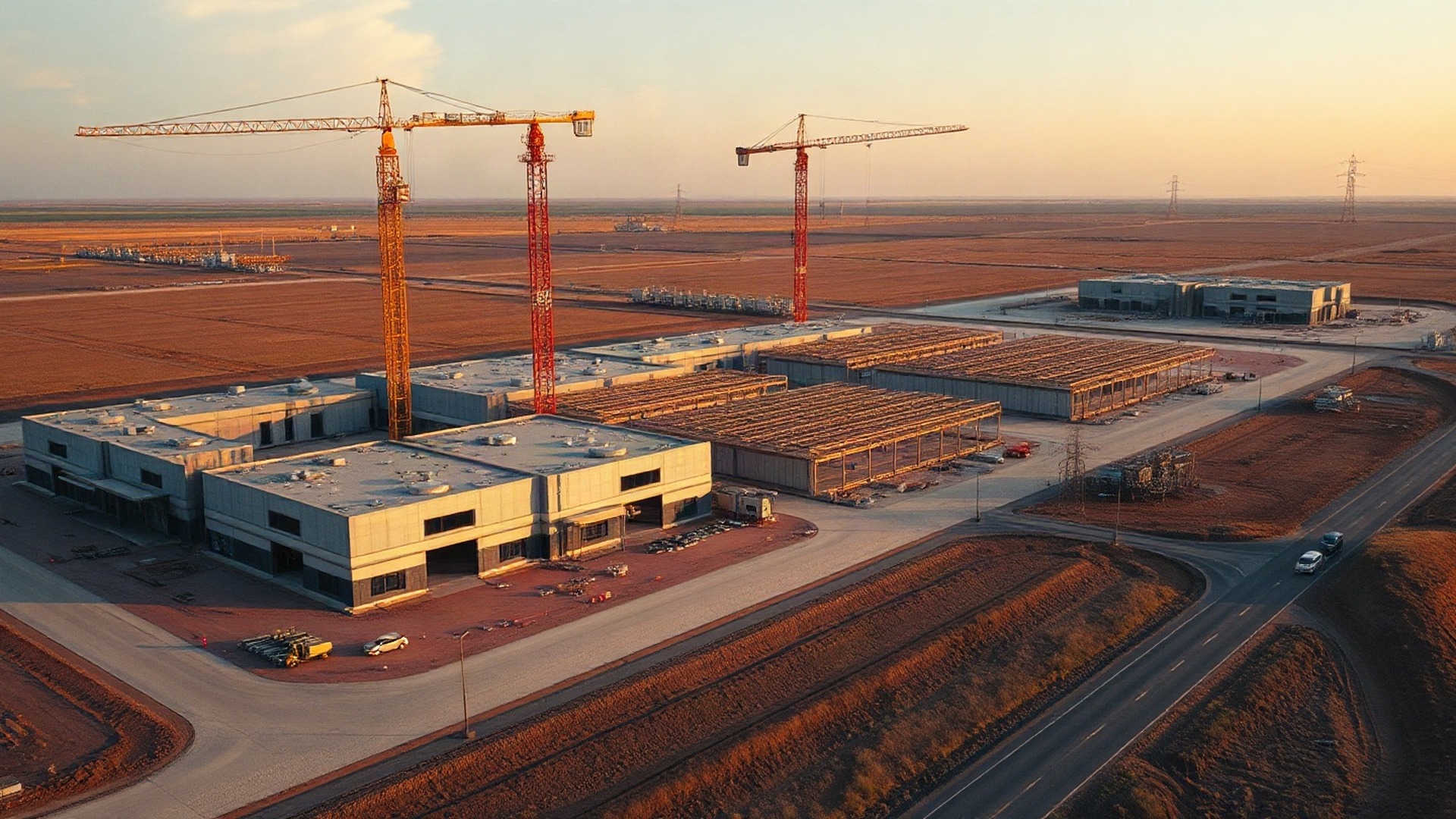
Applied Digital does not design chips, and it does not sell cloud compute subscriptions. The company builds massive, liquid-cooled industrial shells in farm country and leases them to tech giants desperate for electricity. Think of it as a commercial landlord for the artificial intelligence era, where the tenant covers the utility tab and the property is essentially a power station with a roof.
You can buy all the graphics processors you want, but they are expensive paperweights without a wall outlet that can handle them. Applied Digital finds rural land with surplus power, navigates the grid queues, pours concrete, and signs tenants to fifteen-year leases. The customers take on the hardware risk. Applied Digital simply collects rent on the space and the plugs.
The model is catching fire right now because the digital economy has hit a physical wall. Power, not computer code, is the binding constraint on the entire sector buildout. Tech companies are running out of substations in Northern Virginia and Silicon Valley. Applied Digital steps in with secured grid capacity in places like North Dakota, Louisiana, and Alabama, handing compute providers ready-to-use capacity years before utilities could build new substations from scratch.
| Price LIVE | $23.68 |
| Market Cap | $7.16B |
| Forward P/E | -30.2 |
| Total Revenue (TTM) | $872.3M |
| 52-Week Low | $19.00 |
| 52-Week High | $50.72 |
| Analyst Consensus | Strong Buy (15 analysts) |
| Analyst Target Mean | $64.27 |
The Grid Queue as a Moat
In commercial real estate, location is about foot traffic and school districts. In high-performance compute hosting, location is entirely about megawatts. If you want to connect a utility-scale data center today, you can wait years in a regional interconnection queue. Getting a utility to approve a high-voltage hookup is harder than building the actual data hall.
Applied Digital bypasses urban grid congestion by setting up where electrons are cheap and underused. The company holds leases covering roughly 1.41 gigawatts of critical IT load across five specialized campuses. That digital load is anchored by approximately 2.15 gigawatts of grid-connected utility power.
Securing that power requires local buy-in that technology firms rarely manage on their own. At its Polaris Forge 1 campus in Ellendale, North Dakota, the facility's use of surplus regional grid capacity has returned more than $45 million in electricity credits to local ratepayers. The project was named Project of the Year by the Mid-America Economic Development Council.
"As new data center development becomes more difficult in certain markets, we believe the scarcity value of established, powered, and community-supported campuses increases," noted Wes Cummins, chairman and chief executive. He spoke in the company's fiscal first-quarter release on Oct. 7, 2026. "Put simply, we view every new restriction elsewhere as making what we already own harder to replicate."
Scarcity creates pricing power. Alongside its operational footprint, the company secured up to about one gigawatt of potential power capacity in Finland, marking its initial entry into Europe. It also locked down a power purchase agreement with Base Electron for power from a planned 1,200-megawatt natural gas plant in North Dakota. Meanwhile, an active 250-megawatt expansion pipeline is slated to close by the end of the calendar year at rental rates at least 15% higher than previous contracts.
How the Lease Engine Works
To understand the business, you have to separate a standard office lease from a critical infrastructure contract. Applied Digital leases its facilities under fifteen-year take-or-pay agreements. In plain English, the tenant pays the full bill whether they fill the room with servers or leave the floor completely empty.
Those long-duration contracts insulate the asset owner from tech hardware cycles. The company has assembled approximately $36 billion in contracted revenue over its base fifteen-year terms. If customers exercise all their contractual renewal options—extending occupancy out to thirty years—that backlog jumps to roughly $86 billion. About 70% of that total contracted revenue is underwritten by investment-grade American hyperscalers.
Yet the headline earnings print looks radically different from a clean rent roll. Total revenue for the fiscal first quarter of 2027 surged 322% year over year to $341.9 million, up from $80.9 million a year earlier. Adjusted EBITDA jumped to $64.4 million, compared to just $0.5 million in the prior-year period. Net operating income hit $58.8 million, while operating cash flow flipped positive at $63.9 million.
The composition of that revenue tells the real operational story. The core high-performance computing hosting division generated $262.6 million during the quarter. Base rental checks accounted for just $65.8 million of that figure, while tenant utility recoveries added $13.3 million. The lion's share—$183.5 million—came from one-time tenant fit-out services.
Tenant fit-outs are simply the custom electrical and liquid-cooling work Applied Digital performs to get a building ready for specific servers. It is low-margin, pass-through construction activity. The unit delivered an operating profit of $33.4 million, proving the construction work pays its own way, but it is not the annuity equity investors are looking to own long-term. Elsewhere, the legacy Bitcoin and data center hosting operations brought in $37.8 million across 286 megawatts at two North Dakota sites. The company also still holds a roughly 96% stake in ChronoScale, its spun-out cloud-compute business.
Funding the Concrete
Building gigawatt-scale real estate is a voracious consumer of balance-sheet capital. Capital spending in the fiscal first quarter reached approximately $2.07 billion on property and equipment alone. That follows a prior fiscal year where the company put $2.87 billion to work building out physical capacity.
Managing that cash burn requires deep debt markets. The company holds about $3.7 billion in cash, cash equivalents, and restricted cash against $6.4 billion in total debt. On paper, that leverage looks aggressive, but the maturity schedule provides breathing room. Management noted that more than 80% of that debt principal is not due until fiscal 2031 or later.
More importantly, the company's cost of capital is trending downward as projects hit completion. Early funding secured against the Polaris Forge 1 facility required senior notes carrying a 9.25% coupon. In June 2026, Applied Digital priced a $1.59 billion debt tranche at a 7% coupon. The cheaper capital funded the third building at Polaris Forge 1 and retired an interim $300 million bridge loan.
That refinancing means the entire 400-megawatt CoreWeave footprint at Polaris Forge 1 and the 200-megawatt build at Polaris Forge 2 are fully funded. The next development slate—Polaris Forge 3, Delta Forge 1 in Boyce, Louisiana, and Delta Forge 2 in Alabama—requires new project-level capital. Because all three sites are leased to the same tier-one, investment-grade tech giant, management plans to tap project-finance markets rather than rely solely on costly high-yield bonds.
Live capacity is beginning to catch up with the capital outlay. Polaris Forge 1 holds 250 megawatts of operational capacity across two buildings and ten data halls, helped by a 75-megawatt phase energized on Oct. 1, 2026. Management is targeting 300 operational megawatts across North Dakota by the end of calendar 2026. It also expects more than 600 megawatts energized across the footprint over the next twelve months. The longer plan puts between 3.5 and 4.0 gigawatts online by the end of 2030.
The Short Seller's Sheet
Bears see this narrative not as an infrastructure blue chip, but as a heavily indebted real estate speculation play tied to two volatile counterparties. Strip away the $183.5 million in one-time construction billing, and actual quarterly rent was an unimpressive $65.8 million. The company is funding massive construction programs with debt and equity offerings while long-term cash flow is still ramping up.
The customer concentration presents an immediate vulnerability. Outside of CoreWeave—a specialized, debt-heavy compute provider taking all of Polaris Forge 1—the projects still waiting on financing lean on one unnamed hyperscaler. That tenant signed Polaris Forge 3, Delta Forge 1 and Delta Forge 2. If it slows its capital commitments, the pipeline stalls out.
The balance-sheet dilution has been relentless. Applied Digital carries $6.4 billion in debt and posted a GAAP net loss attributable to common stockholders of $221.0 million, or $0.76 a share, primarily due to non-cash depreciation charges and paid-in-kind preferred dividends. To stay solvent during this building boom, the company's weighted share count expanded from roughly 201 million to approximately 292 million shares over the past two years. Short sellers are betting heavily that construction delays or refinancing hiccups will break the model: as of Sept. 30, 2026, 56.6 million shares were sold short, representing 21.5% of the public float.
Why It Matters to the Stock
The disconnect in the equity comes down to how the market values contractors versus how it values utility assets. Applied Digital shares trade roughly half off their late-May highs, sitting largely unmoved following the triple-digit revenue print. Wall Street is currently valuing the company as a volatile commercial builder whose revenue happens to spike when it installs cooling equipment for third parties.
For the stock to experience a durable structural re-rate, the revenue mix has to flip from construction billing to high-margin base rent. The market pays a contractor's multiple for one-time tenant fit-outs. It pays a landlord's multiple for fifteen-year, take-or-pay checks signed by investment-grade balance sheets.
Every building that powers on swaps low-margin construction fees for predictable, high-margin rental income. Wall Street analysts maintain a consensus Strong Buy rating across 15 firms tracked by S&P Global, with an average 12-month target of $64.27 and estimates stretching from $22 up to $93. Because the company does not issue financial earnings guidance, the equity trades strictly on physical delivery milestones.
Execution is the only catalyst that will force short sellers to cover. The company has to deliver its scheduled 300 megawatts in North Dakota by the close of calendar 2026. Then it must prove it can bring the next 600 megawatts online across the portfolio over the following four quarters without issuing dilutive equity. What we are watching closely heading into the next fiscal quarter is the execution of that 250-megawatt pipeline expansion to verify if new leases actually clear at the guided 15% pricing premium.
If management secures those higher rates and finances its next three campuses below high-yield debt levels, the market will stop pricing Applied Digital as a construction crew. It will start treating it like an indispensable digital utility.
The transformation from speculative builder to institutional landlord happens the moment those fifteen-year rent checks outgrow the construction bills.
Disclosure: The Signal holds no position in APLD. Positions may change. This is not financial advice.