Amphenol touched an all-time high in early October, then promptly lost roughly 18% of its value across twelve trading sessions. That slide included a brutal 7.7% drop on Oct. 22, a session when the company did not put out a single press release. It was simply swept into an indiscriminate hardware selloff triggered by Meta trimming capex forecasts and posting its first negative free cash flow in over a decade.
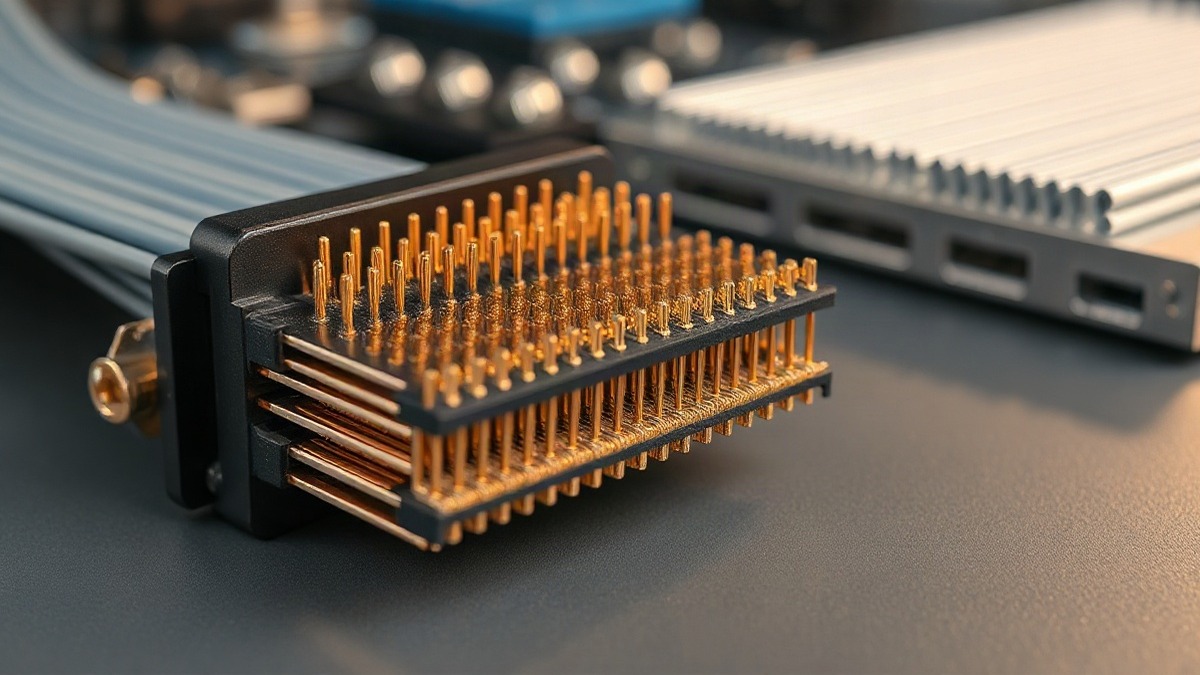
When markets panic over hardware spending, investors dump everything with a plug. That creates an opening to look at what Amphenol actually does. In plain terms, the company builds the physical bridges of modern computing: the connectors, backplane systems, cable assemblies, and sensors that shuttle electrical signals and power between hardware components. If a graphics processing unit needs to send data to a network switch, or a cockpit sensor needs to talk to a flight computer, Amphenol makes the joint. It builds the physical connection that lets that conversation happen.
Think of an advanced computing cluster as a massive professional kitchen. Silicon makers like Nvidia design the high-profile line cooks, but Amphenol manufactures every counter, rack, and conveyor belt moving the ingredients between stations. For decades, this was an unglamorous industrial supplier serving aerospace, automotive, and telecom clients across forty countries. Today, it is an essential toll-taker in artificial intelligence infrastructure.
In its second quarter, the IT datacom segment brought in $3.8 billion, accounting for 43% of total revenue. That division grew 63% organically, with chief executive R. Adam Norwitt noting that virtually all of that sequential burst came directly from AI deployments.
| Price LIVE | $74.09 |
| Market Cap | $182.7B |
| Forward P/E | 22.2x |
| Total Revenue (TTM) | $29.0B |
| 52-Week Low | $59.01 |
| 52-Week High | $89.93 |
| Analyst Consensus | Strong Buy (19 analysts) |
| Analyst Target Mean | $102.97 |
The company protects that franchise through an unconventional operational structure. Rather than running a centralized corporate bureaucracy, Amphenol operates through more than 140 independent business units. Each general manager owns specific customer specifications and locks their proprietary designs directly into client hardware programs. Once an Amphenol connector gets designed into a proprietary server rack, a customer cannot simply replace it for a cheaper part; doing so requires a lengthy engineering re-qualification process. That entrenched position helped Amphenol generate $11.5 billion in connector sales in 2024, placing it second globally just behind TE Connectivity's $12.9 billion. Following the recent acquisition of CommScope's connectivity business, Amphenol’s total connector sales likely overtake TE this year—an inference supported by CommScope's projected $4.6 billion contribution.
The intellectual debate around the stock centers on physics: specifically, the link budget. When high-frequency electrical signals travel across a circuit board, they lose strength quickly, a degradation measured in decibels. On a standard 40-decibel loss budget for next-generation 224-gigabit links, routing copper traces through conventional circuit board material burns through 34.2 decibels, leaving a razor-thin margin of error.
Amphenol bypasses that bottleneck by plugging directly into the chip package itself, bypassing the circuit board entirely. That design slashes signal loss down to 22 decibels, leaving 18 decibels of headroom. On next-gen cabling, that margin buys roughly 3.8 meters of physical reach—plenty of distance to link adjacent server racks entirely with copper. Optics might own the long horizon, but copper still owns the room.
To understand why this matters to the equity, you have to look past overall AI enthusiasm. Amphenol trades at roughly 22 times forward earnings, carrying a clear premium over TE Connectivity's multiple near 16 times. The stock does not need hyperscalers to double their budgets to re-rate higher; it needs copper to hold its share of the connection budget while hardware volumes scale. The math requires two milestones in that print: organic datacom expansion matching management's guided mid-teens sequential pace, and adjusted operating margins holding firm near 28.5%. If the company proves its copper platforms remain unchallenged inside the rack, the valuation holds.
The short case, however, argues that this premium rests on borrowed time and financial optics. Consensus estimates project earnings growth to step down from roughly 61% this year to around 24% next year. If growth cools and the valuation multiple converges toward TE's lower tier, the stock faces nearly 30% downside. Furthermore, roughly half of the company's recent top-line expansion was purchased through deals like the $10.5 billion CommScope buyout, leaving goodwill and intangibles sitting at 51% of total balance-sheet assets. Second-quarter operating margins also received an 80-million-dollar lift from one-time tariff recoveries, masking underlying operational baselines. Add in $18.8 billion in total debt and an unresolved hundred-million-dollar tax audit in China, and any sudden deceleration in hyperscaler spending leaves a crowded long trade completely exposed.
What we are watching on Wednesday, October 28, is whether adjusted operating margins stay above 28.5% without any tariff assistance. If margins dip below that threshold, the market will treat the recent record profitability as a temporary accounting windfall.
Disclosure: The Signal holds no position in APH. Positions may change. This is not financial advice.