You can throw the biggest party on Wall Street and still watch the room clear out early. Arista Networks just posted its fastest quarterly revenue expansion since going public in 2014, beating the Street's revenue estimate by roughly 10% and guiding the current quarter to grow at nearly the same clip. Yet even after a post-earnings pop, the stock trades roughly a fifth below its early-October highs. The market is not questioning whether AI infrastructure is booming. It is asking who actually captures the value when the dust settles.
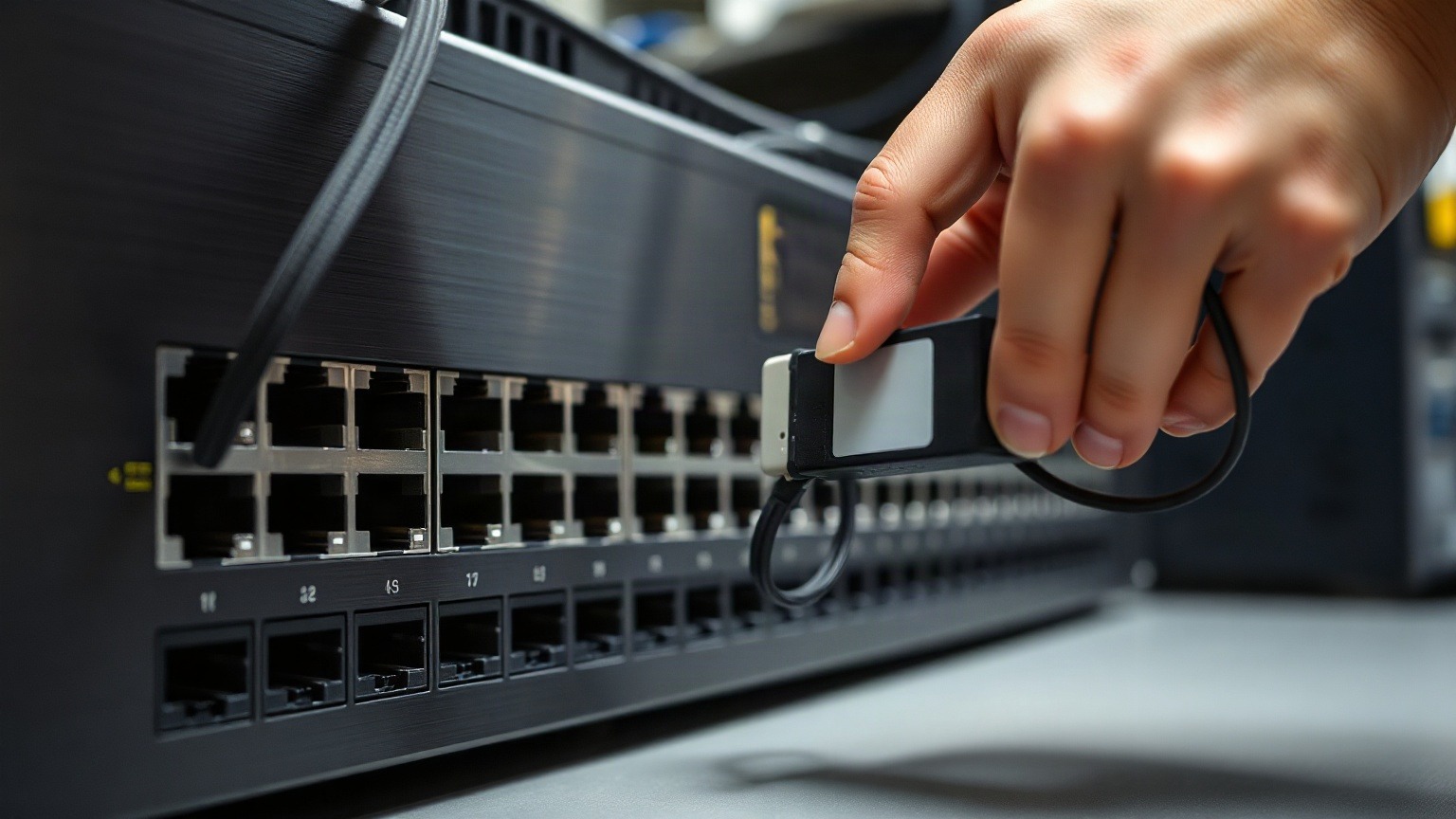
To understand the hesitation, look at what Arista actually sells. If an AI data center is a sprawling metropolis, Arista builds the superhighways. It makes the high-speed Ethernet switches that ferry data packets between server racks, backed by its own EOS software that keeps traffic flowing. Arista does not fabricate its own silicon. It buys merchant chips from Broadcom and wraps them in custom hardware and networking software.
That plumbing is the quiet bottleneck of the generative AI boom. When you query a chatbot or train an image model, thousands of processors must sync their math at once. If the network stutters, nine-figure computing clusters sit idle, burning expensive power while they wait for data. Ethernet already won the contest to connect racks across the facility, pushing InfiniBand into a minority role. The next battleground sits inside the rack itself, right next to the accelerators.
| Price | $169.91 LIVE |
| Market Cap | $214.3B |
| Forward P/E | 32.5x |
| Total Revenue (TTM) | $11.9B |
| 52-Week Low | $114.52 |
| 52-Week High | $217.41 |
| Analyst Consensus | Strong Buy (28 analysts) |
| Analyst Target Mean | $245.50 |
Arista's latest print laid bare the financial mechanics of that race. Revenue surged 58.5% to $3.66 billion, easily clearing projections of roughly $3.33 billion. Demand is being pulled rather than pushed: sales and marketing expenses rose just 3.6%. Yet beneath that blowout top line, gross margins tell a sober story. GAAP gross margin contracted roughly one hundred basis points to 63.6%. Growth got cheaper to book and more expensive to earn.
The compression happens because hyperscale cloud operators possess terrifying leverage. Think of your annual smartphone upgrade: carriers offer sweet trade-ins because they know you have nowhere else to go. In Arista's world, cloud giants buy switches by the container ship and demand punishing price concessions. The company's filings openly admit that the discounts on massive orders hurt gross margins. Selling more gear to the world's largest balance sheets is a great way to grow, but a tricky way to expand profitability.
Arista's answer is to march into the server rack before rivals lock it down. Nvidia ruled internal rack communications with its proprietary NVLink interconnect. Arista is pushing back with an open rack architecture called Etherlink SU-144, built with a partner list that includes Meta, Microsoft, AMD and Broadcom. The goal is to link up to 144 accelerators in a single hop, then scale past a thousand across racks. If that standard catches on, Arista sells the entire nervous system. If it stalls, it stays a peripheral vendor.
A seasoned short-seller would look at this quarter and spot a commodity trap in disguise. Arista relies on Broadcom for silicon while selling into two unnamed cloud giants that generate 42% of revenue. Industry data shows contract manufacturer Celestica already outsells Arista in back-end AI Ethernet switches, a sign that hyperscalers are happy to buy unbadged white boxes. Meanwhile Nvidia grabbed the top spot in data-center Ethernet with more than 20% share by bundling network hardware directly with its GPUs. When your gross margin leaks while your biggest customers buy unbranded boxes, blowout growth looks less like a moat and more like a treadmill.
For the equity to break out, Arista has to show it owns the network rather than merely visiting it. Investors need its rack-scale Ethernet portfolio to deliver material revenue in 2027 while gross margin holds inside management's 62% to 64% corridor. Campus and enterprise sales, a goal of at least $1.25 billion this year, have to dilute the top-heavy customer base. If pricing power holds against the cloud giants, the discount vanishes. If margins erode further, the skepticism is justified.
What we're watching is the gross margin line in the fourth-quarter report, where the company guided revenue to between $3.9 billion and $4.0 billion. A top-line beat tells you cloud spending is healthy. Margin stability tells you who holds the power. In the AI infrastructure race, raw volume is easy to find. Pricing leverage is the only thing that lasts.
Disclosure: The Signal holds no position in ANET. Positions may change. This is not financial advice.