Think of your home Wi-Fi versus the high-speed fiber running under your street. Outside your house, standardized protocols govern everything. But step inside an artificial intelligence server rack today, and you are trapped on a private island.
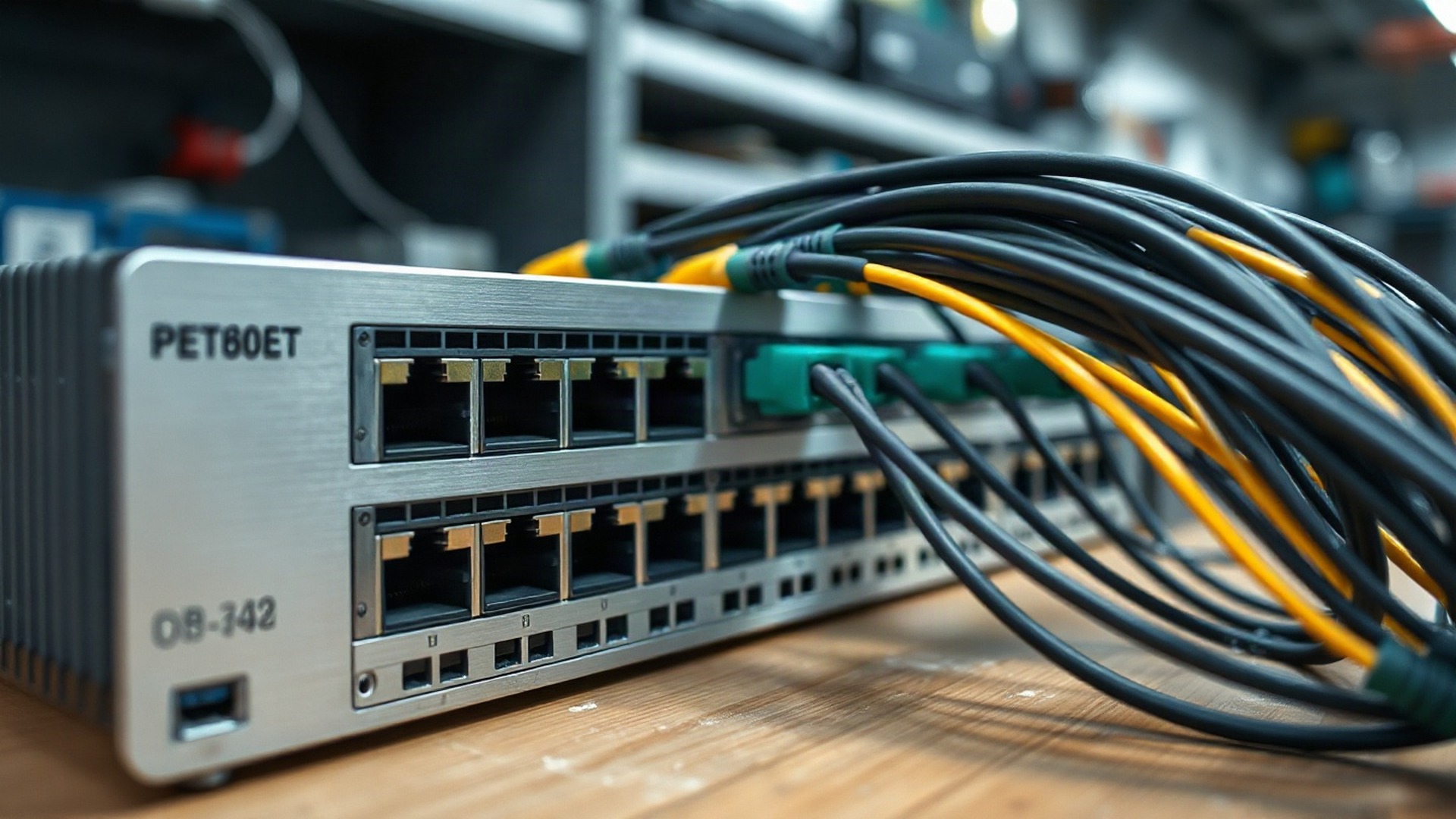
Arista Networks builds the ultra-fast Ethernet switches and software that glue massive data centers together. When cloud giants like Microsoft and Meta construct vast halls of AI clusters, Arista supplies the high-speed network fabric that keeps those chips talking. Nvidia sells off-the-rack suits; Broadcom is the bespoke tailor. Arista is the road system those suits get driven on. Until now, the driveway inside each house was entirely private.
On October 7, Arista decided to pave that driveway. The company unveiled an open Ethernet rack-scale portfolio for both scale-up and scale-out infrastructure, engineered alongside AMD, Arm, Broadcom, d-Matrix, Meta, Microsoft, and Qualcomm. The headline launch is the Etherlink SU-144, an architecture that links up to 144 accelerators across a single-hop network and scales to 1,024 chips through cross-rack topologies.
This is Ethernet walking straight into the last room Nvidia owns.
| Price LIVE | $210.97 |
| Market Cap | $266.1B |
| Forward P/E | 40.6x |
| Total Revenue (TTM) | $10.54B |
| 52-Week Low | $114.52 |
| 52-Week High | $217.32 |
| Analyst Consensus | Strong Buy (29 analysts) |
| Analyst Target Mean | $242.55 |
The Battle of the Backplane
To grasp why this matters, you have to understand how an AI data center is wired. Networking happens in two distinct zones: scale-out and scale-up. Scale-out is the interstate system, connecting thousands of separate server chassis across a data hall. That has long been Ethernet's home turf, where Arista dominates alongside standard merchant silicon.
Scale-up, however, is the tight, blistering loop inside a single rack. This is where dozens of specialized accelerator chips must share memory and exchange parameters at near-zero latency, effectively acting as one gargantuan super-chip. For years, that scale-up layer has been locked down by Nvidia’s proprietary interconnect, NVLink. If you bought Nvidia’s leading systems, you bought their private cabling, their switches, and their terms.
Arista's argument is that proprietary interconnects have been outpaced by the sheer size of frontier AI models. As Tyson Lamoreaux, Arista's senior vice president of cloud and AI networking, put it: "The network in the AI era is no longer just an independent pipe between servers. It's now a tightly integrated rack-scale backplane that is essential to maximizing compute."
The technology rests on Ethernet for Scale-up Networks, an Open Compute Project workstream founded in late 2025. Its founding members include AMD, Broadcom, Meta, Microsoft and OpenAI. The initiative has since swelled to more than 175 participating companies. By pushing the newly ratified standard into physical hardware, Arista wants to turn what was once a captive chipmaker monopoly into an open merchant ecosystem.
When a technology shifts from closed architecture to open standards, history usually rhymes. It happened to IBM mainframes, it happened to RISC workstations, and it is now knocking on the door of the AI server rack.
Plumbing for Megawatts
Moving Ethernet into the scale-up domain is not simply a software trick; it requires wrestling with brutal physical engineering. Modern AI racks consume staggering amounts of electricity, creating heat pockets that standard air conditioning cannot touch.
Arista's scale-up designs feature three physical form factors: an orthogonal chassis, a cabled backplane, and a cross-rack setup. The orthogonal chassis delivers single-hop, single-rack connectivity with support for 100 to 400 kilowatts of liquid cooling. To put that in perspective, 400 kilowatts is enough sustained power to run an entire neighborhood of suburban homes, all packed into a steel frame the size of a commercial refrigerator.
The accompanying scale-out designs pack liquid-cooled 7060EX7 switches pushing 102.4 terabits per second per switch. Arista wraps these in reference frames fitted with integrated liquid manifolds, drip trays featuring active leak detection, rack controllers, and battery backup shelves.
The density upgrades are equally dramatic. Today’s pluggable optical switches deliver 1.6 petabits per second per rack. Arista’s next-generation optical options lift that throughput to 6.5 petabits per second per rack, which cuts the required physical footprint inside a data center by nearly half. At the software tier, everything runs on a common foundation dubbed Netdi, operating either through Arista's proprietary EOS or open network operating systems.
The fine print matters, though. Industry observers rightly describe this release as a reference architecture strategy, not an immediate off-the-shelf SKU launch. Arista’s own Vijay Vusirikala was blunt regarding Nvidia’s installed base: "There is no near-term opportunity because that is proprietary."
Instead, this offensive targets the rest of the industry. AMD’s Instinct chips, Qualcomm’s data center portfolio, startup platforms like d-Matrix, and Microsoft’s custom Maia silicon all need a high-performance backplane to survive. None of them can build an end-to-end coherent rack alone. Arista is offering to be their common nervous system.
The Growth Engine Under the Hood
This aggressive expansion comes from a position of remarkable operational strength. In its second-quarter earnings, Arista pulled in $3.036 billion in revenue, up 37.7% year-over-year. It marked the company’s first-ever $3 billion quarter, comfortably outpacing internal guidance.
Operating margins sat at an enviable 49.9% on a non-GAAP basis, yielding $1.3 billion in net income for the quarter. Over the trailing twelve months, Arista has generated $10.54 billion in revenue alongside roughly $5.2 billion in free cash flow. Its pristine balance sheet carries around $13.3 billion in cash and short-term investments, with zero debt.
Management has raised its full-year revenue outlook three times, pointing to roughly $12.6 billion, or approximately 40% growth. Anchoring that trajectory is the dedicated AI Fabrics unit, which management expects to deliver at least $3.5 billion in revenue this year alone.
Yet these surging headline numbers mask an uncomfortable customer reality. According to Arista’s regulatory filings, two customers accounted for 42% of total revenue in fiscal 2025. One customer represented 26% of sales, while another accounted for 16%. Those buyers are Microsoft and Meta. While chief executive Jayshree Ullal anticipates adding one or two more 10% customers to the roster, Arista's short-term fate remains tightly tethered to the capital expenditure budgets of Menlo Park and Redmond.
Why It Matters to the Stock
Arista shares trade near record territory, carrying a premium valuation of roughly 41 times forward earnings. For a hardware-adjacent business, that multiple reflects an assumption that the AI fabric engine will continue compounding well past the current $3.5 billion annual target.
The market has fully priced in Arista's victory in scale-out networking. What is not priced in is scale-up option value.
To justify an equity multiple that already assumes flawless execution, Arista must prove it is more than just a vendor riding the coattails of hyperscaler building cycles. It must demonstrate that it can capture the lucrative interconnect spend that currently belongs to Nvidia. If Etherlink SU-144 gains commercial traction and translates into booked rack deployments for non-Nvidia chips over the coming quarters, Arista opens a massive new revenue surface. That transition from an external cable provider to an indispensable on-rack backplane is what would trigger a sustained multiple re-rate.
If scale-up remains a whiteboard ambition, the stock is merely an expensive, high-beta play on tech-giant capital spending.
The Bear Case
The short-seller thesis against Arista writes itself: this is a business priced for absolute perfection, colliding with structural concentration risk and margin compression.
Relying on two companies for more than four out of every ten dollars of revenue is treacherous. If Meta or Microsoft decides to moderate AI infrastructure outlays, or if either accelerates internal custom networking silicon to cut costs, Arista's growth profile evaporates overnight. Both cloud operators are actively designing proprietary hardware components.
And the scale-up launch changes nothing in the immediate term. Arista readily admits it cannot touch Nvidia's captive clusters today. Meanwhile, margins are already feeling gravity. Second-quarter non-GAAP gross margin dropped to 63.4%, down from 65.6% in the prior year, dragged down by an evolving customer mix and the lower-margin reality of shipping complex, integrated rack enclosures. Broadcom, Cisco, and white-box original design manufacturers are all circling the same Ethernet prize.
What proves the skeptics right is straightforward. If AI fabric sales stumble short of the $3.5 billion milestone, the forward multiple contracts sharply. A full-year target that fails to step higher, or a gross margin beneath the 62% floor, would do the same.
The Open Standard Bet
The broader AI industry is locked in a philosophical contest between proprietary vertical stacks and open horizontal standards. Nvidia has perfected the walled garden, providing accelerators, networking, and software in a tightly managed bundle. It is an extraordinary model, but cloud providers inevitably hate being locked into a single supplier's pricing power.
By coordinating with giants like Meta, Microsoft, and AMD through the Open Compute Project, Arista is executing the classic enterprise playbook. It is assembling an alliance of the willing to commoditize the proprietary layers above and below it.
What we are watching next is the third-quarter earnings report on November 3. Beyond the headline numbers, the critical signal will be whether management reports real production commitments for the Etherlink SU-144, and whether full-year AI Fabric revenue decisively hurdles that $3.5 billion benchmark.
The open network is knocking on the rack door, and the server backplane will not remain private forever.
Disclosure: The Signal holds no position in ANET. Positions may change. This is not financial advice.