
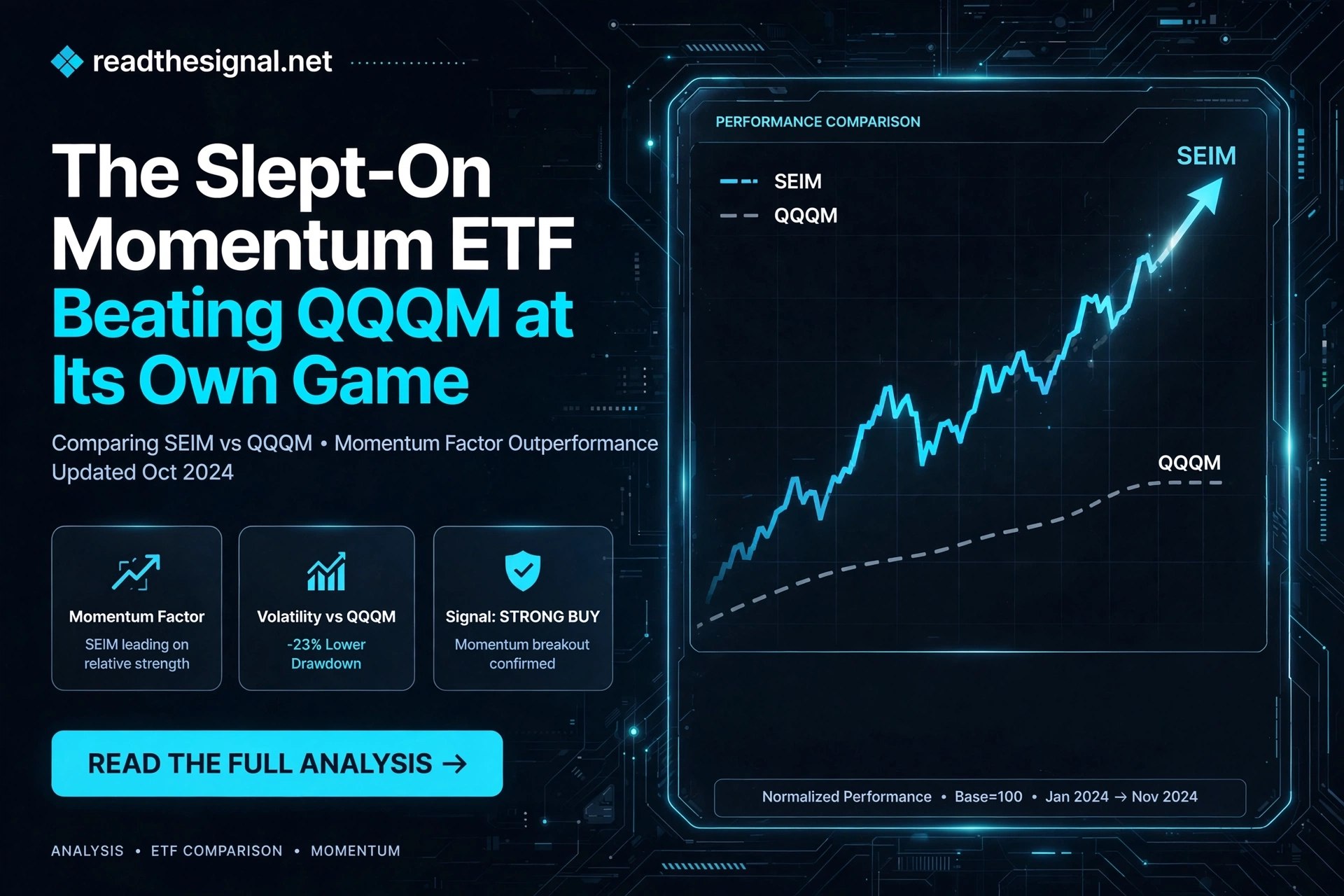
When active investors and retail traders hunt for large-cap momentum and tech exposure, the default reflex is to buy the Nasdaq-100. For years, the Invesco NASDAQ 100 ETF (QQQM) has been the gold standard for cost-effective, long-term tech growth.
But if you look purely at price action and fundamental momentum, QQQM is being quietly outperformed by a fund that most retail investors have never heard of: the SEI QiM U.S. Large Cap Momentum Active ETF (SEIM).
With both funds charging an identical 0.15% expense ratio, the choice between them comes down to methodology and concentration risk. Here is a breakdown of why SEIM deserves a spot on your watch list.
The Default Heavyweight: QQQM
QQQM was launched in 2020 as the modern, cost-efficient sibling to the massive QQQ trust. It holds the exact same 100 non-financial companies in the Nasdaq, but at a cheaper 0.15% expense ratio built for buy-and-hold investors.
The Pros: It is hyper-liquid, passively managed, and dominates during mega-cap tech rallies.
The Risk: You are buying massive sector concentration. QQQM is roughly 50% technology, and its top semiconductor holdings alone account for nearly a quarter of the entire fund. When semiconductors pull back, QQQM takes the full hit.
The Hidden Gem: SEIM
SEIM is a $1.46 billion actively managed fund. While QQQM is handcuffed to the Nasdaq-100 index rules, SEIM uses a proprietary quantitative model to hunt for U.S. large-cap stocks exhibiting the strongest price and fundamental momentum, regardless of sector.
Who is Running SEIM?
If SEIM is a hidden gem, it's only because its issuer, SEI Investments Management Corporation (SIMC), historically caters to institutions rather than retail traders. SEI manages massive asset pools globally and provides wealth management tech to major banks and hedge funds.
SEIM is run by SEI's Quantitative Management (QiM) team. This isn't a discretionary fund where a single star manager picks stocks based on gut feeling. The QiM team operates systematically, using algorithmic multi-factor models that score stocks on:
- Price Momentum: Historical price appreciation across multiple time horizons.
- Fundamental Momentum: Positive earnings revisions and business health metrics.
Why SEIM is Outperforming
SEIM has delivered a cumulative price return of more than 110% over the last three years, alongside a 1-year return of more than 20%.
The secret to this outperformance lies in its dynamic sector rotation. Because SEIM evaluates earnings revisions alongside pure price action, it doesn't just blindly hold tech. It captures momentum leaders across the entire market.
While QQQM explicitly excludes financial stocks, SEIM actively capitalizes on them. Among SEIM's top holdings, you will find tech giants like Alphabet and NVIDIA, but they sit alongside momentum leaders in financials (Visa, Bank of New York Mellon) and industrials (Caterpillar).
The Bottom Line
Both ETFs cost 0.15% to hold. If you want pure, unadulterated exposure to Nasdaq technology and semiconductors, QQQM is arguably the best passive vehicle on the market.
However, if your portfolio is already overweight in tech and you want a systematic, institutional-grade momentum strategy that dynamically hunts for winners across all sectors—including financials and industrials—SEIM is a superior active alternative. It caps single-stock risks lower than QQQM while consistently proving it can beat the Nasdaq at its own game.
This article was written on August 10, 2026. The Signal is not a registered investment advisor. Do your own research.
Disclosure: The Signal holds no position in SEIM. Positions may change. This is not financial advice.