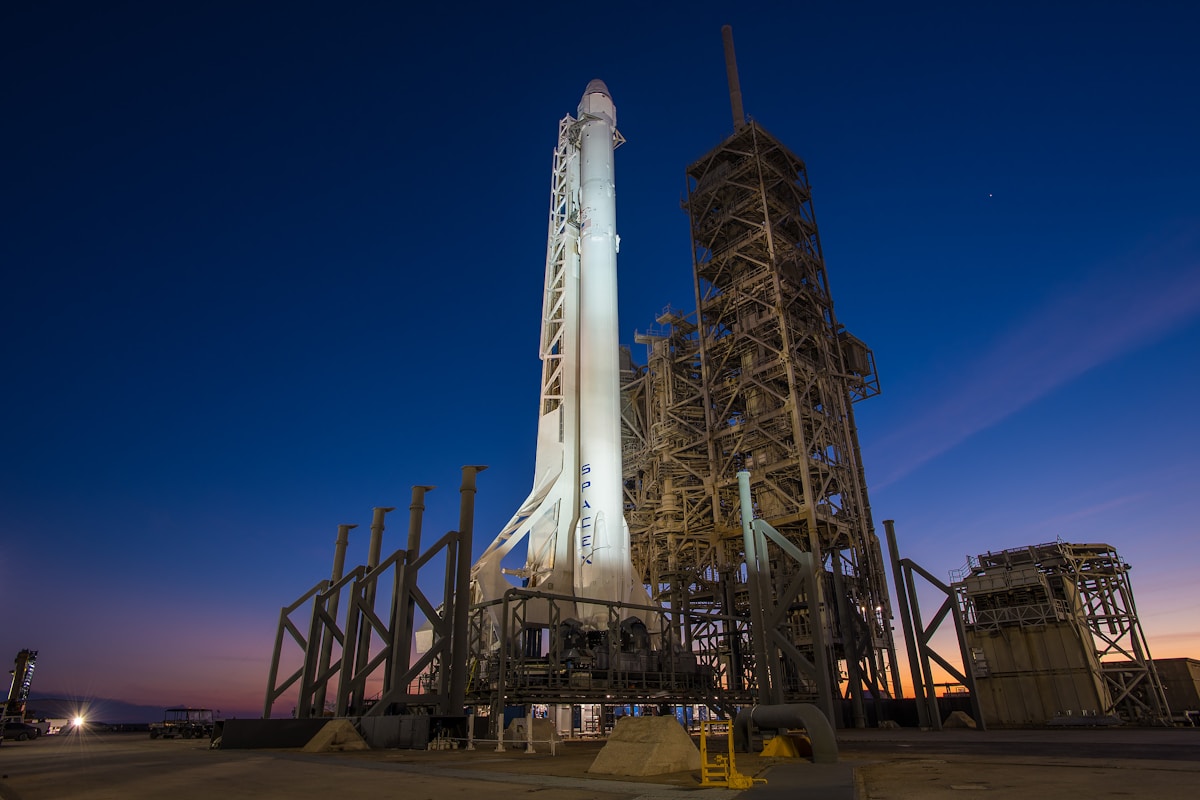
Every time Rocket Lab makes the news, it's the same story: a sleek Electron rocket piercing the night sky, and analysts debating if the upcoming Neutron rocket can challenge SpaceX. The entire narrative is built on fire, smoke, and steel.
But if you're only looking at the launchpad, you're missing the real business.
While the retail crowd treats Rocket Lab (RKLB) like a pure-play launch company, institutional money knows the truth: Rocket Lab is quietly transforming into a diversified space tech giant, and their biggest cash cow isn't rockets at all.
The Present: Space Systems is the Real Cash Cow
If you look at the company's record $200.3 million Q1 2026 revenue, a fascinating disparity emerges.
The launch business — powered by Electron and the lucrative HASTE hypersonic defense program — brought in $63.7 million (roughly 32% of the pie). The real engine driving Rocket Lab right now is their Space Systems division, which pulled in a staggering $136.7 million (68% of total revenue).
Rocket Lab isn't just the delivery truck; they build the actual cargo. Space Systems manufactures complete satellite platforms (like their Photon bus), flight software, solar arrays, star trackers, and reaction wheels. When defense agencies or commercial giants need a constellation, they contract Rocket Lab to build the spacecraft from scratch. Selling the parts and the ecosystem is where the real margin hides.
The Future: The Neutron Multiplier and Total Vertical Integration
So, why build the medium-lift Neutron rocket if launch is the smaller slice of revenue? Because Neutron changes the unit economics of the entire business.
- The Launch Margin Leap: An Electron launch brings in roughly $8 million. When Neutron debuts in late 2026, it will command $50 million to $55 million per dedicated flight. Because Neutron is designed for rapid first-stage reusability, fixed costs plummet, driving target gross margins to 40%–50%.
- The Acquisition Moat: Rocket Lab is aggressively eating the supply chain. Recent acquisitions like Mynaric AG (laser optical communications for satellite inter-links) and Motiv Space Systems (advanced space robotics) mean they no longer pay middlemen for high-value tech. They build it all in-house, capturing maximum profit on their $2.2 billion backlog.
The End Game: Constellations as a Service
The ultimate destination for Rocket Lab isn't just selling hardware to other companies. CEO Peter Beck's ultimate play is owning and operating their own mega-constellation to sell data and connectivity directly to global enterprises and governments.
Think about the math. A competitor has to pay a manufacturer for satellites, a launch provider for a rocket, and a tech firm for laser components. Rocket Lab owns the rocket factory (Neutron), the satellite factory (Photon), the laser tech (Mynaric), and the launchpad. They can deploy an entire orbital network at a fraction of the cost of anyone else on Earth.
The Signal Takeaway
Don't get distracted by the spectacular videos of boosters falling back to earth. Rocket Lab's launch capabilities are simply the toll booth at the entrance to space. Launch gets them into orbit, but Space Systems pays the bills — and ownership of the infrastructure will turn them into an empire.