$315 to $1,150 in six months. Let that sit for a second. Micron Technology didn't climb the charts — it detonated. Year-to-date return: +265%. Market cap just shattered the $1.3 trillion ceiling on May 26th, joining the trillion-dollar club alongside tech royalty. And here's the kicker most people are sleeping on: this company sells memory chips. Not GPUs. Not custom silicon. Memory.
| currentPrice | $1,150.95 |
| marketCap | $1.3T |
| ttmRevenue | $90.3B |
| revenueGrowth | +345% YoY |
| forwardPE | 7.7x |
| trailingPE | 26x |
| grossMargin | 84.6% |
| ytdReturn | +265% |
| hbmSpeed | 9.6 Gbit/s/pin |
| institutionalOwnership | 81.5% |
| analystTarget | $1,454 mean |
| manufacturingCommitment | $200B+ |
The memory trade nobody saw coming.
While everyone was watching NVIDIA print money on AI accelerators, Micron was quietly becoming the most profitable memory company in the history of semiconductors. TTM revenue? $90.3 billion — up 345% from a year ago. Q3 FY2026 alone brought in $41.5 billion. The quarter before? $23.9B. Before that? $13.6B. Each quarter roughly doubles the last. That's not a business cycle. That's a phase shift.
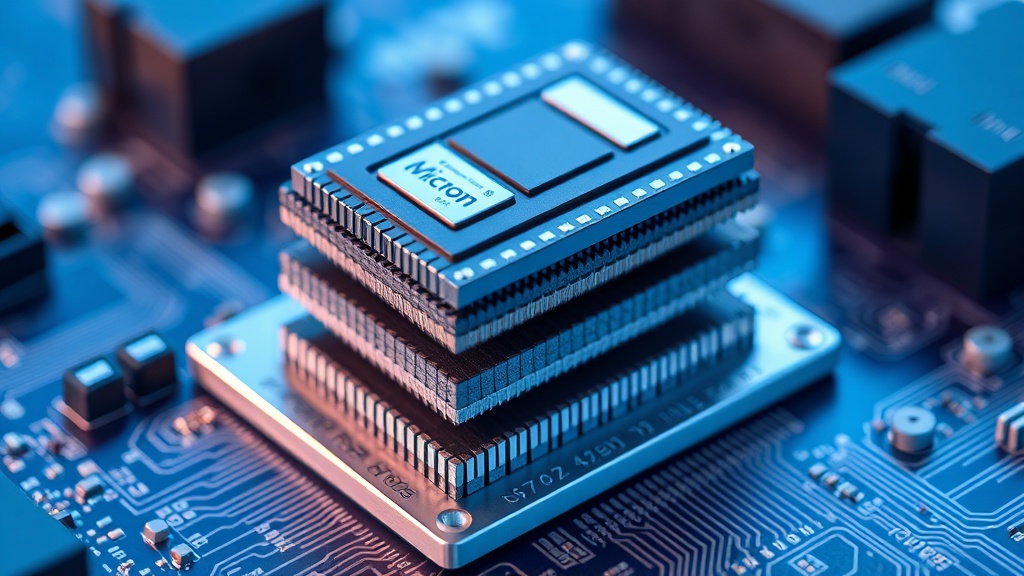
So why is Micron suddenly printing cash like it's a central bank? One word: HBM. High Bandwidth Memory. Every NVIDIA GPU going into a data center needs HBM stacked right next to it. It's the fuel. And the Big Three controlling global DRAM supply? SK Hynix at 38%. Samsung at 30%. Micron at 25%. That's 93% of all memory on Earth made by three companies. Oligopoly doesn't begin to describe it.
But here's where it gets interesting. Micron has the fastest HBM on the market right now. Their HBM3E runs at 9.6 Gbit/s per pin — 50% faster than HBM3 — delivering 1.2 TB/s bandwidth and 24GB per stack. NVIDIA buys it. AMD buys it. Apple buys it so aggressively that Tim Cook publicly blamed Micron for a $300 iPhone price hike this week. When the CEO of Apple is complaining about your product prices on a conference call, that's not a problem. That's demand.
| Metric | Value |
|---|---|
| Stock Price | $1,150.95 |
| Market Cap | $1.3 Trillion |
| YTD Return | +265% |
| TTM Revenue | $90.3B (+345% YoY) |
| Gross Margin | 84.6% |
| Forward P/E | 7.7x |
The margin story is even wilder than the revenue story. Gross margins just hit 84.6% in Q3 FY2026. For context, that's higher than most software companies. Memory used to be a brutal commodity business — boom, bust, pray, repeat. Not anymore. When you have three sellers, infinite AI demand, and supply constraints that won't resolve until at least 2028, pricing power looks exactly like this.
And here's the supply kicker. Every wafer converted to HBM takes three times the production capacity of standard DDR5 memory. So every chip Micron makes for AI literally shrinks the supply of regular memory too — which pushes prices up across the board. Memory prices have surged over 200% since early 2025. Both sides of the equation working in Micron's favor simultaneously.
CEO Sanjay Mehrotra has been clear: "gradual improvement" in supply won't arrive until 2028. Until then, the shortage persists. Every major cloud provider, every AI lab, every GPU manufacturer is fighting over the same three sources of HBM. And Micron is the only one with the fastest next-gen product shipping at scale today.
The valuations tell two completely different stories. Trailing P/E of 26x looks reasonable for a company growing revenue 345% annually. But the forward P/E? 7.7x. Analysts are projecting earnings so explosive that next year's estimates make today's price look cheap. The consensus target among 40 analysts sits at $1,454 — median of $1,533, high end at $2,200. That's nearly double where the stock trades today.
The institutional verdict is unambiguous. 81.5% institutional ownership. Beta of 2.2 — this stock moves like a leveraged ETF on AI demand. When the sector runs, MU runs twice as hard. The 52-week range tells the story: a low of $103 and a high of $1,255. That's the volatility you're signing up for.
But here's the structural argument that makes the ride worth it. Micron just committed over $200 billion to US manufacturing — $24 billion in Singapore, $100 billion for a new mega-fab in New York state. This isn't a company riding a temporary boom. This is a company building the physical infrastructure of AI memory for the next decade.
Chip stocks now represent a record 19.7% of the S&P 500. The entire market is repricing around AI infrastructure. And at the very center of that repricing — the component no GPU, no server, no data center can function without — sits chips stacked in 3D, made by three companies on Earth, with one of them trading at 7.7 times next year's earnings.
The memory trade isn't over. It just started.
Disclosure: The Signal holds no position in MU. Positions may change. This is not financial advice.