Intuitive Machines just quietly stopped being a moon company. The Houston-based builder of lunar landers delivered second-quarter results on August 13 that had less to do with craters and everything to do with satellites: a $600 million-plus contract to build three commercial geostationary (GEO) communications satellites for an undisclosed customer, with deliveries spread across the next 30 months. Over the past year the company has bolted together satellite manufacturing, ground stations, and data services into what it calls a full-stack space infrastructure business, and this quarter was the first time that strategy showed up in the order book at scale. Shares climbed after the report as investors digested a quarter that missed the headline numbers yet delivered on the strategy.
| Price LIVE | $19.01 |
| Market Cap | $3.1B |
| Forward P/E | N/M |
| Total Revenue (TTM) | $484M |
| 52-Week Low | $7.78 |
| 52-Week High | $46.75 |
| Analyst Consensus | Buy |
| Analyst Target Mean | $32.33 |
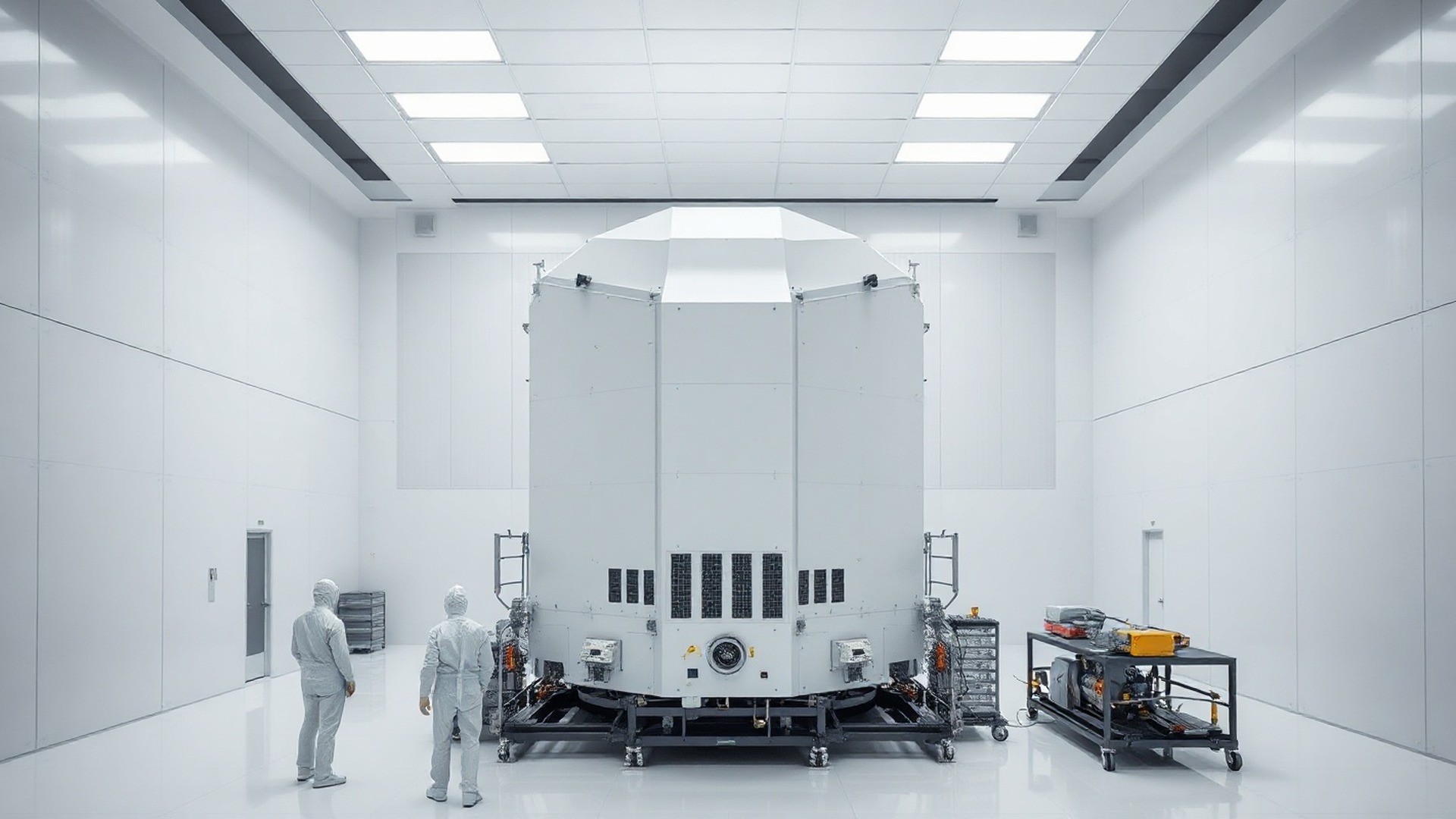
The contract rides on the IM 1300 satellite bus, the workhorse platform Intuitive Machines inherited when it closed its roughly $800 million acquisition of Lanteris Space Systems — formerly Maxar Space Systems — in January. That deal, announced in early November, was the moment the strategy shifted from “get to the moon” to “own the high ground between Earth and it.” CEO Steve Altemus laid the win out plainly on the earnings call: three geostationary communication satellites from an undisclosed customer, valued at over $600 million over the next 30 months. The mystery customer matters less than the pattern — commercial orders, recurring revenue, and a bus with decades of flight heritage behind it.
The national security line is the quiet accelerant. National security revenue went from roughly 3% of the mix a year ago to 30% in the second quarter, sitting between 38% civil and 32% commercial. The marquee driver is the Space Development Agency’s AMDT3 “Golden Dome” program, where Intuitive Machines is building 18 spacecraft under an L3Harris prime contract announced in early August. Add more than 70 IM-300 spacecraft under contract — and more than 80 spacecraft across all platforms — and the company reads less like a niche lander shop and more like a full-stack manufacturer with a genuine order book. That mix shift is deliberate: defense and intelligence customers order in constellations and pay on schedule, smoothing the lumpiness that plagues one-off lunar missions.
The numbers back the narrative. Second-quarter revenue hit $206.17 million, roughly four times the $50.31 million posted a year earlier, while gross margin swung positive to 17.4% from negative a year ago. The print came in a touch under the ~$223.84 million consensus, and the bottom line was a $0.29 loss per share versus the $0.09 analysts expected — a miss on both lines, but one the market shrugged off because the durable story is the backlog. Order intake of $920 million in the quarter, plus roughly $300 million more awarded quarter-to-date in Q3, pushed the backlog to a record ~$1.76 billion at June 30 — the biggest in company history and well over a full year of expected revenue.
Management reaffirmed full-year guidance of $900 million to $1 billion in revenue with positive adjusted EBITDA — a milestone that would mark a genuine turning point for a pre-profit company — and sketched the conversion path: 25–30% of the backlog becomes revenue this year, 35–40% next. The balance sheet is still a work in progress: roughly $367 million in cash and short-term investments against about $455 million of total debt, with free cash flow negative as the company spends ahead of its revenue curve. The early-August close of the Goonhilly Earth Station and COMSAT acquisitions, for about $49.6 million, adds a global space-to-ground data-services network spanning LEO, MEO, GEO, and cislunar space, giving the satellite backlog a natural downstream customer.
The bottom line: the bull case no longer depends on any single lunar mission going right. Intuitive Machines has diversified across civil, commercial, and national security demand, stacked a record backlog, and assembled the manufacturing and ground-network assets to execute on it. Shares have climbed back above $19 for the first time since early July, though they still trade far below the highs they touched in the spring. This is a company that has graduated from narrative to backlog. For investors the setup is straightforward: a pre-profit manufacturer with a validated bus, a government-heavy customer base that tends to pay, and a clear path to EBITDA profitability. The risk is execution and the balance sheet; the reward is a company that has outgrown its origin story. Hitting those conversion percentages is the only thing standing between it and the next leg up.
Disclosure: The Signal holds no position in LUNR. Positions may change. This is not financial advice.