
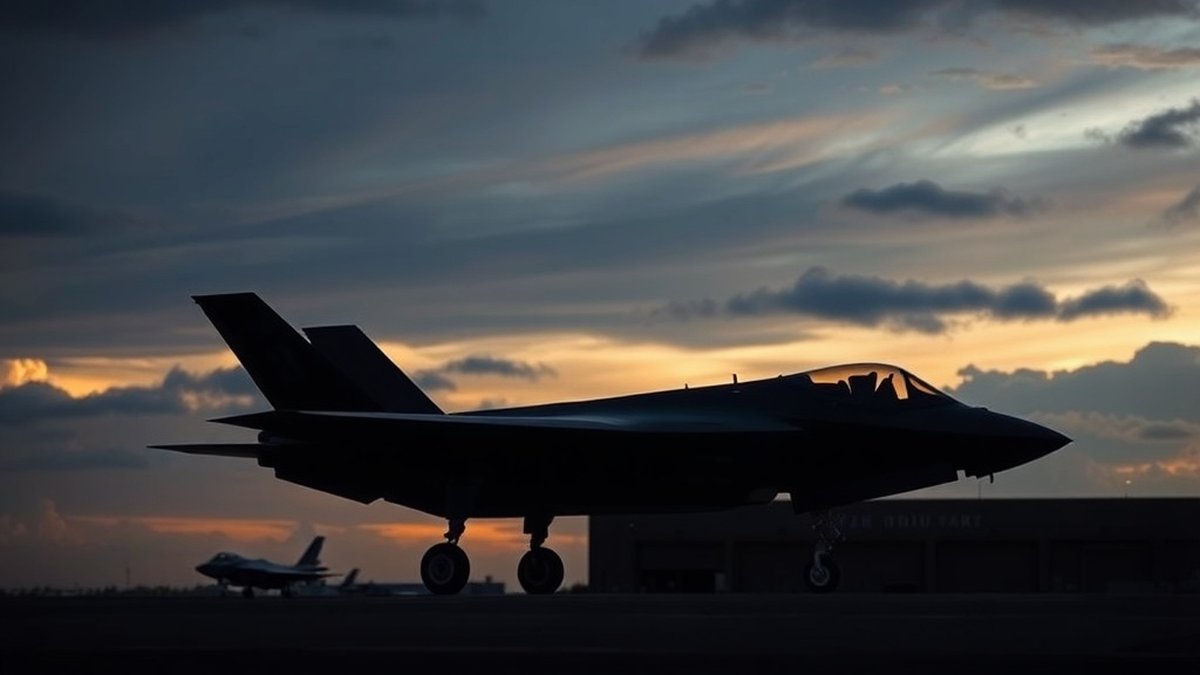
Imagine being the only game in town for the most advanced fighter jet on the planet. Now imagine also being the only company the Pentagon can call when it needs to quadruple missile production at wartime speed. And then imagine holding a $193 billion backlog — that's 2.5 years of revenue already locked in, no matter what the market does tomorrow. That's Lockheed Martin right now, and the market is treating it like it's just another defense stock.
The numbers tell a story that most investors are sleeping on. Lockheed Martin (LMT) sits at $523 as of this writing, a full 24% below its 52-week high of $692. The forward P/E? 16.3x. For a company with $75 billion in revenue, $5 billion in net income, and a backlog so deep it could survive a recession without booking a single new order. Something doesn't add up.
Let's start with what just happened. On June 24, 2026, the Pentagon handed Lockheed a $35 billion contract to ramp THAAD interceptor production. This isn't just a big number — it's the largest munitions procurement order since World War II. Lockheed is quadrupling THAAD output at its new facility in Troy, Alabama, where it just broke ground on a $1.25 billion expansion that doubles the plant's footprint. Robotics, additive manufacturing, the whole future-of-defense playbook. The company's total investment through 2030? North of $9 billion.
And THAAD is just one piece. PAC-3 MSE production is scaling from 600 interceptors a year to 2,000 — more than triple. The Pentagon burned through tens of thousands of munitions in recent conflicts, and the replenishment cycle is just getting started. NATO allies are racing toward a 3.5% GDP defense spending target. When European capitals start writing checks, Lockheed's missile business is the first vendor they call. There is no alternative supplier at this scale.
Then there's the F-35. Lockheed delivered a record 191 F-35s in 2025. Total delivered: 1,293. Backlog: 368 more. Nineteen allied nations either operate or have ordered the jet. And here's the kicker — there is no competing fifth-generation fighter in production anywhere in the world. Not from Boeing. Not from Europe. Not from anyone. Once a country buys an F-35, it's locked into Lockheed's ecosystem for the next 30 to 40 years. Training pipelines, spare parts, sustainment contracts, software upgrades. The switching cost isn't just high — it's functionally infinite within any relevant planning horizon.
Now add the Trident II D5 missile. Lockheed is the sole provider of the sea-based leg of America's nuclear triad. That's a program that doesn't get canceled. That doesn't get rebid. That runs for decades, full stop.
And then there's Skunk Works. The classified programs we don't know about are arguably worth more than the ones we do. The problem is that one of those classified programs is currently dragging on earnings — a $1.8 billion cumulative loss on a mysterious Aeronautics program that Lockheed can't talk about. That charge, plus F-35 Block 4 software delays and TR-3 combat certification holdups, is why the stock sits 24% below its high. The Q1 miss ($6.44 vs $6.69 expected) didn't help either.
But here's the thing — temporary program charges on classified technology are not the same as a broken business model. Lockheed's Space segment faces real pressure from SpaceX on the launch side, but Lockheed doesn't do launch. It does payloads — the satellites, the sensors, the classified space architectures that SpaceX can't replicate. Different game entirely.
Competitively, Lockheed is the only pure-play defense prime with exposure across every domain — air (F-35, F-16), land (THAAD, PAC-3, HIMARS), sea (Trident, anti-submarine warfare via the newly acquired Ultra Maritime for $3.45 billion), space (GPS, classified payloads), and cyber. RTX competes on missiles and sensors but has no fighter aircraft. Northrop Grumman dominates bombers and space but doesn't build tactical jets. Boeing's defense business is shrinking. There is no other company that does what Lockheed does across the full spectrum.
At $523 with a $120.6 billion market cap and a 2.66% dividend yield, LMT offers a rare combination — a monopoly-level moat, a backlog that covers 2.5 years of revenue, and a cyclical buying opportunity created by temporary program expenses. The munitions supercycle is not a theory. The contracts are signed. The shovels are in the ground in Alabama. The allies are ordering. The only question is whether you have the patience to let a multi-year compounder do its thing while the market obsesses over a quarterly number.
Disclosure: The Signal holds no position in LMT. Positions may change. This is not financial advice.