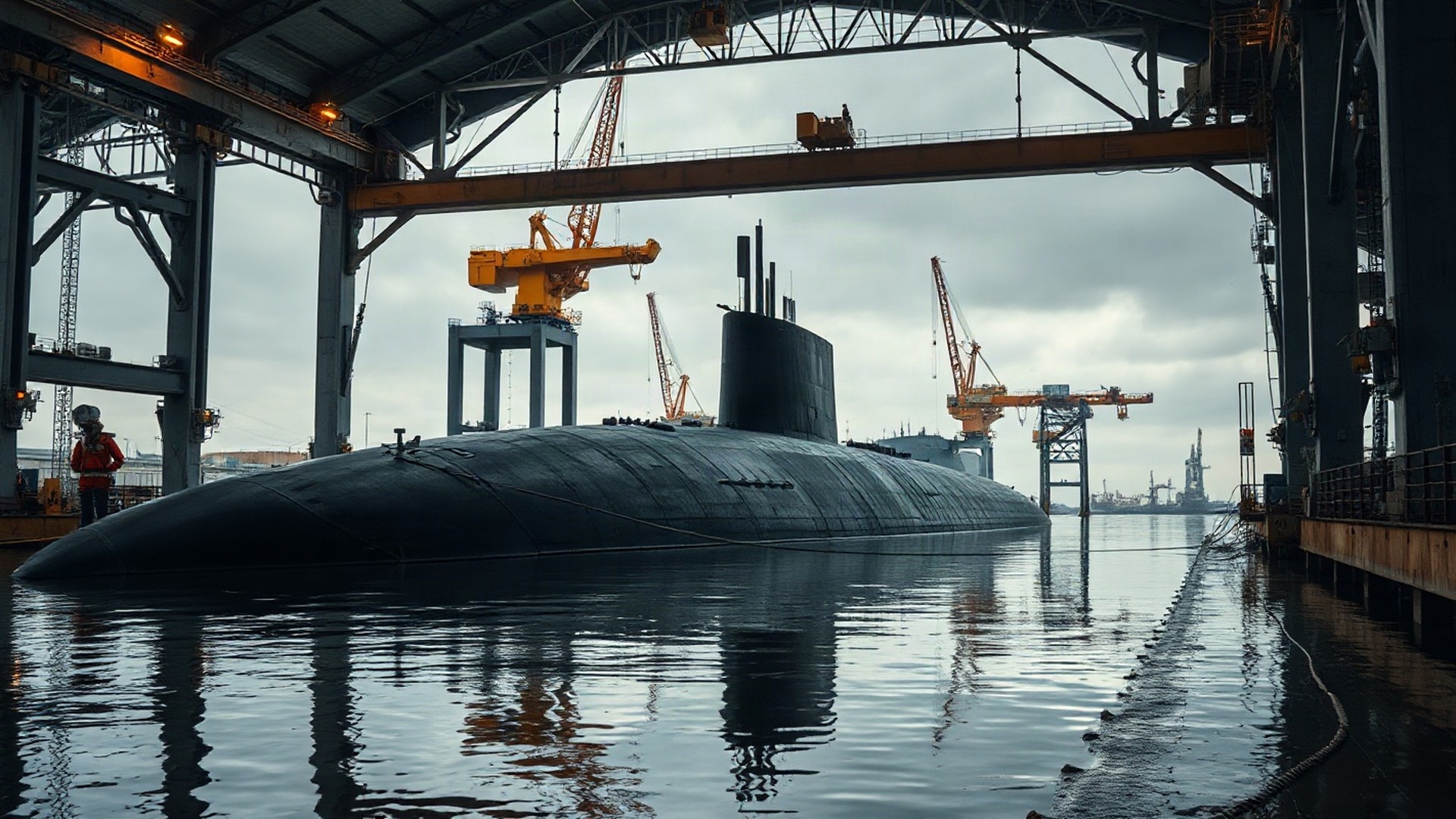
America's nuclear Navy runs on a two-yard duopoly, and it is the most important bottleneck in the defense industrial base. Newport News Shipbuilding and General Dynamics' Electric Boat are the only two U.S. shipyards licensed to build nuclear-powered warships — and among a handful of yards on Earth that can do it at all. Between them they own every submarine and every nuclear aircraft carrier the Navy will sail for the next half century. That scarcity is the whole Huntington Ingalls story, and the numbers just printed show the market is finally pricing it in.
| Price LIVE | $318.34 |
| Market Cap | $12.5B |
| Forward P/E | 15.3 |
| Total Revenue (TTM) | $13.19B |
| 52-Week Low | $262.66 |
| 52-Week High | $460.00 |
| Analyst Consensus | Buy |
| Analyst Target Mean | $368.08 |
The July 30 print was a beat by any measure. Revenue rose 10.9% to $3.418 billion, net earnings jumped 37% to $208 million, and diluted EPS landed at $5.27 against $3.86 a year earlier — roughly 38% ahead of consensus. First-half sales came in at $6.517 billion versus $5.816 billion, with net earnings of $357 million versus $301 million. This is a company compounding, not coasting.
The segment mix is exactly what a shareholder wants to see. Newport News, the crown jewel, grew revenue 15.3% to $1.849 billion on $111 million of operating income at a 6.0% margin, while Ingalls grew 16.7% to $845 million at a fatter 6.9% margin. Only Mission Technologies lagged, down 3.9% to $760 million — a dip the company framed as timing, small next to the shipbuilding machine around it. The yards are pulling the train.
Then came the real headline, announced the night before that print: $76.6 billion in submarine contract modifications — $42.1 billion for nine Block VI Virginia-class boats (plus material for a tenth), $29.5 billion for five Build II Columbia-class SSBNs, and $5 billion for shipyard infrastructure. Newport News' share is roughly $25 billion on the Virginias and $5.5 billion on the Columbias, with Electric Boat as prime on the Columbia. Backlog and remaining performance obligations now stand at $57.3 billion, up from $53.1 billion at year-end; about 35% converts to revenue through 2027 and another 35% by 2029. That is a decade of work, contracted.
Understand what the duopoly really means. Electric Boat builds submarines only; Newport News builds nuclear carriers — CVN-79 Kennedy just finished builders and acceptance trials, with delivery due in 2027 — plus Virginia modules and Columbia sections, and five ships deliver over the next twelve months. There is no second source and no way to fast-track one: standing up a nuclear-certified yard takes a generation. When Washington keeps ordering more boats, the money has nowhere else to go — and that structural position matters more than any single quarter.
Execution is improving, too. Throughput is up 12% year to date against a 15% full-year target, distributed shipbuilding capacity is up 30% as planned, and 3,500 shipbuilders have been hired this year into a workforce of roughly 45,000. On August 6 the company signed performance-based production agreements worth up to $900 million over seven years with Path Robotics and GrayMatter Robotics to put physical-AI welding and fabrication automation on the floor. Labor is the constraint on every naval program; HII is spending real money to engineer around it.
AUKUS is the strategic kicker. Australia buys three in-service Block IV Virginias, refurbished, arriving in 2032, 2035, and 2038 — and the U.S. is trying to double Virginia production to replace them. None of that is direct backlog yet, but every boat sold to Canberra is a boat the Navy must order again. It is a demand signal with a ten-year fuse, and the customer base is expanding, not shrinking.
The bear case deserves air. H1 operating cash flow came in at negative $421 million against positive $428 million a year earlier — working-capital timing and billings, per management — with free cash flow guidance for the year reiterated at $500–600 million. The first Columbia, USS District of Columbia, has slipped to roughly the end of 2028, and cash on hand is a hair over $12 million, though liquidity sits at $1.7 billion. Shipbuilding margin guidance was raised to 6.0–6.5% against a long-term goal of 9–10% — and the gap between today's margins and where this backlog ultimately takes them is the bull thesis in one number.
Ships take years to build and decades to justify. HII is a compounder whose thesis compounds in plain sight: a protected duopoly, a $57 billion backlog, a customer writing ever-bigger checks, and a margin story that has barely started. The stock trades well off its highs after a pullback — for a franchise like this, that reads less like a warning than an invitation. Buy the bottleneck.
Disclosure: The Signal holds no position in HII. Positions may change. This is not financial advice.