Here's the thing about the Pentagon's AI strategy that nobody's pricing into $GOOGL: the Department of Defense just made its biggest bet yet on Google's technology — and it's not for customer service chatbots.
The Pentagon announced Thursday that it has signed agreements with seven major AI companies to deploy their models on classified military networks. Google, Nvidia, Microsoft, Amazon, OpenAI, and two others got the green light. Anthropic? Locked out.
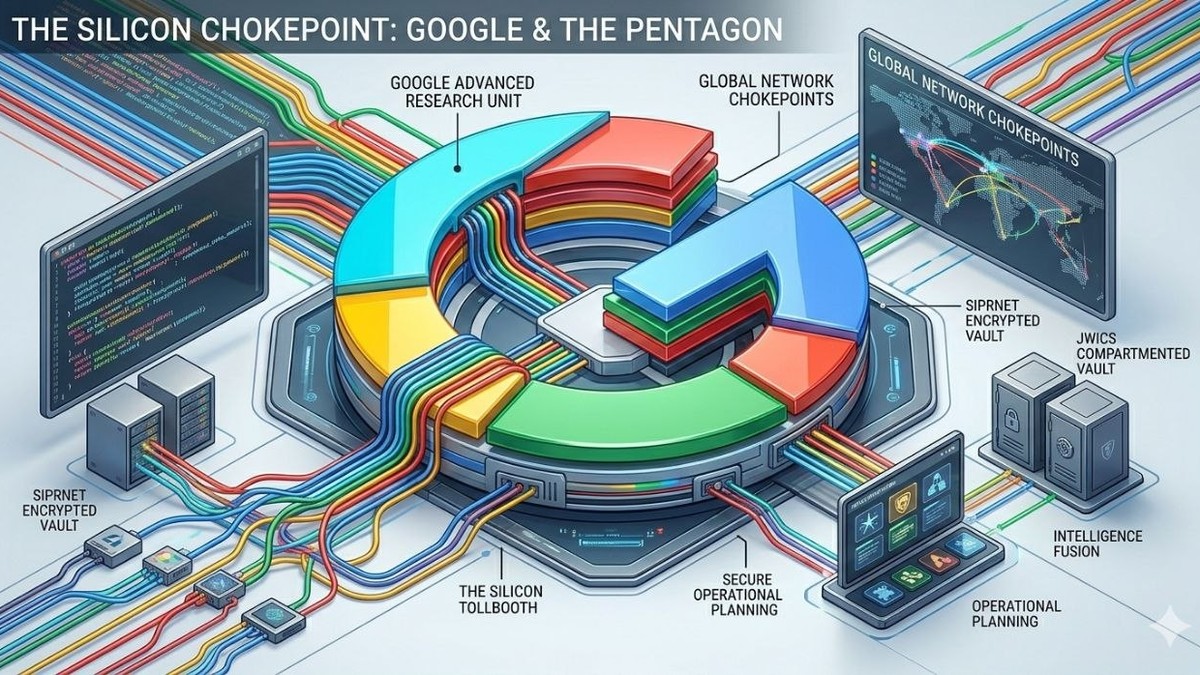
This is a seismic shift. Google's Gemini family of models will now operate on SIPRNet and JWICS — the military's most sensitive classified networks. Think intelligence analysis, operational planning, real-time threat assessment. The stuff that wins wars.
Let's be clear what this means. The Pentagon just spent years and billions trying to build its own AI infrastructure. After the Project Maven controversy in 2018 — where Google employees forced the company to pull out of drone footage analysis — Big Tech kept the military at arm's length. Not anymore.
"The Department will never again rely on a single AI provider," a senior Pentagon official told reporters. Translation: they're building an AI supply chain with multiple vendors, and Google just got a seat at the table that Anthropic left empty.
The numbers tell the story. $GOOGL trades at $376.43 with a market cap of $4.56 trillion. Revenue hit $422.5 billion — up 21.8% year-over-year. Net income of $160.2 billion. A forward P/E of 26x, which is cheap for a company growing revenue at 22% with AI tailwinds accelerating across every segment.
Analysts love it. Fifteen analysts cover the stock with a Strong Buy consensus and an average price target of $417.74 — 11% upside from here. The stock sits 7% below its 52-week high of $404.47, meaning there's room to run if the market starts pricing in this Pentagon revenue stream.
What Google Gets
The classified AI deal isn't a single contract — it's a framework. Google will provide Gemini models, Cloud AI infrastructure, and security-cleared engineering support to the Pentagon's classified networks. The exact dollar figures are classified (obviously), but comparable JWICS modernization contracts run $500 million to $2 billion annually.
More importantly, this resets Google's relationship with the defense establishment. After Project Maven, DoD viewed Google as unreliable for sensitive work. This deal erases that stain. Google can now bid on the full spectrum of defense AI contracts — from the $3.2 billion Golden Dome missile defense AI system to real-time battlefield intelligence.
"Google is now a defense AI prime contractor," said one industry analyst. "That wasn't true six months ago."
The Employee Backlash — And Why It Doesn't Matter
Over 600 Google employees signed a letter to CEO Sundar Pichai demanding the company reject classified military AI work. DeepMind workers announced a unionization vote in direct response. The letter warns of "irreparable damage" to Google's brand and AI ethics reputation.
Here's the reality: Google's stock doesn't care. The revenue opportunity in defense AI is estimated at $7 trillion over the next decade across the entire ecosystem. Google can't afford to sit that out while Microsoft and Amazon lock up Pentagon cloud contracts.
Sundar Pichai has been here before. He navigated the 2018 Project Maven revolt by declining to renew the contract. But the calculus has changed. China's military AI spending is accelerating. The Pentagon is desperate for commercial AI tools it can trust. And Google's business model is increasingly dependent on enterprise AI revenue — the defense sector is the biggest enterprise customer on earth.
Pichai's response to employees was measured but firm: Google's AI Principles allow work that protects national security, and the company will continue to engage with the Department of Defense within those boundaries.
The Market Takeaway
This deal transforms $GOOGL's defense narrative from zero to hero in one announcement. The stock has been range-bound between $350 and $404 for months as investors waited for a catalyst. This is it.
At 26x forward earnings with 22% revenue growth, a $4.56 trillion market cap, and now a direct pipeline to Pentagon AI spending, Google is arguably the most interesting mega-cap AI stock in the market right now. Microsoft trades at 33x. Amazon at 38x. Google? The cheapest of the bunch with arguably the most underappreciated defense AI opportunity.
Your move.