
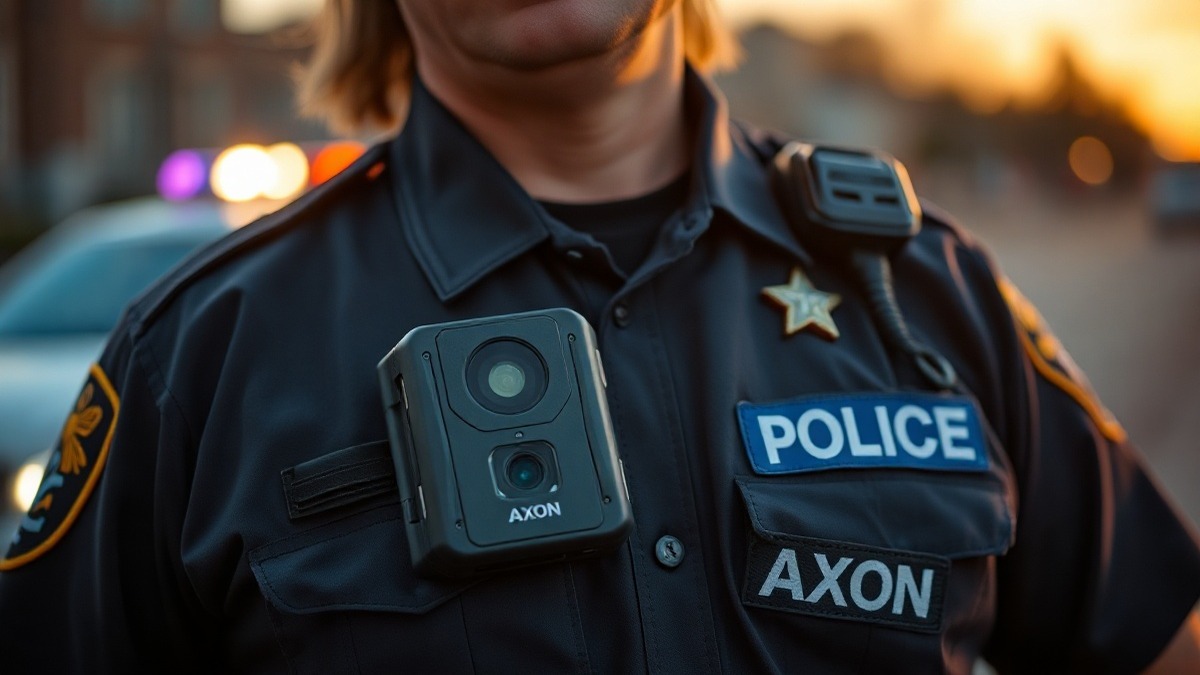
A patrol officer's body camera captures a traffic stop. By the time the officer is back at the station, a draft report already exists — written by AI that listened to the audio and assembled the narrative. That is Draft One, quietly the most important product Axon has ever shipped. More than 600 departments have turned it on, producing over 600,000 reports and saving officers 300,000 hours of typing. But the real story is not the efficiency. It is what Draft One does to the business model: converts a hardware company with a cloud attachment into a data monopoly with a subscription attached.
The conventional read is that Axon makes TASERs and body cameras, with the cameras a nice adjacency. That read is a decade out of date. The TASER remains a dependable cash generator, but the moat lives in the software stack above the hardware: Axon Evidence, the cloud where footage, chain of custody, and case files live; Axon Records for paperwork; Axon Respond for live incident oversight; and Axon Air and Dedrone drones overhead. Software and services now account for 44% of revenue at gross margins north of 80%, against roughly 56% for hardware. The mix shift is the whole game.
The latest quarter shows how far the flywheel has spun. Axon reported $904 million in revenue, up 35% year over year, with annual recurring revenue crossing $1.6 billion, up 39%. Management raised full-year guidance to 32–34% growth, extending four straight years above 30% with trailing revenue near $3.2 billion. But the two stats that matter most are net revenue retention of 126% and future contracted bookings of $15.1 billion. That backlog is roughly four years of revenue already sold. Customers are not buying TASERs and cameras; they are signing long-term contracts to run their whole evidence operation on Axon.
That shift is the moat, and here is why it is so hard to attack. Body camera footage is not like a CRM database. It is the evidentiary record of criminal prosecutions, with chain-of-custody and discovery obligations attached. Once a department's footage, reports, and case files live in Axon Evidence, switching vendors means re-litigating thousands of cases, retraining every officer, and explaining to a judge why the record moved. In practice, nobody does it. Axon serves 20 of the 25 largest municipal police departments in the United States, and the ones already on the platform keep buying more. Motorola's WatchGuard brand keeps trying, but years of effort have not dented Axon's grip on flagship agencies.
The AI Era Plan announced earlier this year shows management knows exactly what it is sitting on. Departments that commit get Draft One plus the full evidence stack, and they have responded with a wall of money — $750 million in bookings in year one. Draft One only works properly with Axon-captured data, and improves as it ingests more of it. Every report written and department onboarded makes the product better for everyone on the network. That is a data-network effect — precisely the compounding advantage competitors cannot buy their way past. It is also acquiring where it makes sense: the $391 million Dedrone counter-drone deal closed in July, Fusus added real-time video sharing, and a $40 million telecom deal extends broadband-first sharing. International revenue doubled to about a fifth of the total, and the playbook is just starting overseas.
None of this means the stock is risk-free, and the bears have real ammunition. Stock-based compensation ran to roughly $634 million last year against $124.7 million in GAAP net income — dilution is a genuine cost of doing business. Tariffs are squeezing hardware margins, one reason the mix shift to software matters. An FTC challenge to the old Vievu acquisition lingers as an overhang. And the AI story cuts both ways: a Forbes investigation this summer raised pointed questions about Draft One's accuracy, and a bad output attached to an officer's name is a reputational nightmare. Municipal budgets — the ultimate customer — tighten in every downturn. The market proved the downside last fall, when shares fell roughly 60% in the SaaSpocalypse before rebounding.
The bottom line. The TASER made Axon famous, but the evidence cloud made it indispensable, and Draft One just made it harder to leave. Management's 2028 targets of $6 billion in revenue and a 28% adjusted EBITDA margin sketch a compounding machine with years of runway. The catch: the market knows it, and the premium valuation leaves no room for a stumble. The moat is real. The growth is real. The valuation is not cheap. For patient investors who can stomach the volatility, this is a business worth owning — even as the bears wait for a switch that never comes.
Disclosure: The Signal holds no position in AXON. Positions may change. This is not financial advice.