ASTS
SpaceX vs. AST SpaceMobile: The $6 Billion Fight for Your Phone's Signal
Bloomberg reports both companies are circling Grain Management's nationwide 800 MHz spectrum — the low-band airwaves that make satellite-to-phone work — in a land-grab worth up to $6 billion. ASTS shares climbed more than 5% Friday. Here's why the winner builds a decade-long moat, and what it means for the AI buildout.
Aug 21, 2026
5 minutes
Bloomberg reports that SpaceX and AST SpaceMobile are both among the bidders for Grain Management's nationwide 800 MHz low-band spectrum portfolio — the airwaves that make satellite-to-phone connectivity actually work. The prize is valued at roughly $6 billion, and ASTS shares climbed more than 5% Friday on the report. Keep the champagne on ice: nothing is signed, no company has confirmed a thing, and it's all sourced to "people familiar with the discussions." But the fact that two of the biggest names in space are circling the same airwaves tells you exactly where this industry is headed.
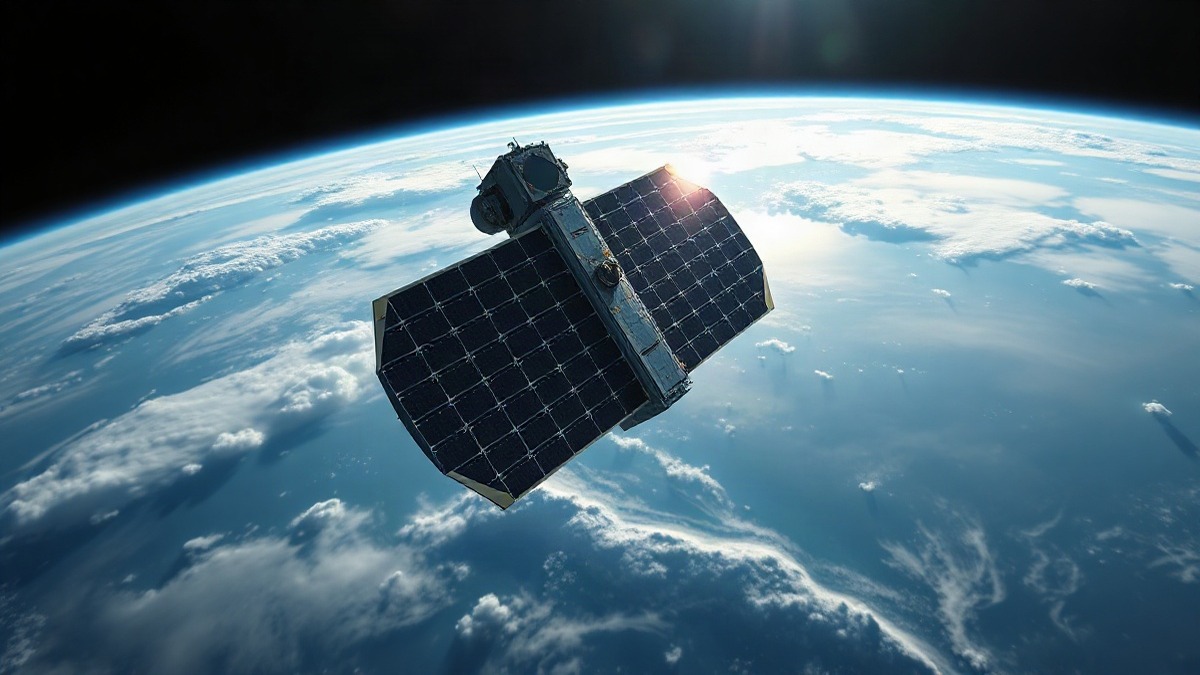
If you haven't met AST SpaceMobile yet, here's the thirty-second version. Founded in 2017 and headquartered in Midland, Texas, it's building a cell tower in the sky: a fleet of giant low-Earth-orbit satellites called BlueBird, each with an antenna roughly the size of a city block, that beam standard cellular signal straight down to ordinary, unmodified smartphones. No special chip, no app, no dish — your phone just works. ASTS doesn't sell phones or plans; it sells connectivity wholesale, through roughly 60 mobile-network partners like AT&T, Verizon, Vodafone, and Orange, that together reach more than 3 billion subscribers.
The Numbers That Matter
| ASTS PriceLIVE | $65.06 |
| Market Cap | $19.5B |
| Forward P/E | N/A |
| Total Revenue (TTM) | $115.3M |
| 52-Week Low | $36.08 |
| 52-Week High | $133.86 |
| Analyst Consensus | Hold |
| Analyst Target Mean | $78.48 |
Price refreshes live · All other figures as of August 21, 2026
Here's what everyone's actually fighting over. The Grain portfolio covers 817–824 MHz uplink and 862–869 MHz downlink — low-band airwaves that travel for miles and punch through buildings, exactly what direct-to-device satellites need. It spans 3,224 counties, which is nearly all of America. The backstory is wild: T-Mobile inherited this spectrum through its Sprint merger, never used it, and sold it to Grain Management on August 11 for $2.9 billion. Grain is now looking to flip or lease it for roughly $6 billion, with preliminary offers due the first week of September.
Here's the part that should grab anyone watching the AI buildout. That buildout runs on two pillars — compute and connectivity. Everyone's fighting over GPUs; almost nobody's talking about the second pillar, the network that lets AI-driven services actually reach devices. Autonomous vehicles, drones, IoT sensor fleets, edge AI agents, remote industrial operations — they all need a connection wherever they are, and "wherever" is usually somewhere with no tower in sight. ASTS is the pure-play on that connectivity pillar, and spectrum is the scarce fuel that makes it work.
Which brings us to the marquee fight of the space-connectivity era: SpaceX versus AST SpaceMobile. The two are already the biggest names in direct-to-device, and whichever side locks up nationwide low-band spectrum walks away with a decade-long moat. That's why Friday's move happened — this isn't an earnings story, it's an infrastructure story.
ASTS also has a head start on the very frequencies in play. The FCC last week granted the company a 30-day authorization to test direct-to-device service on those same 800 MHz bands, using up to 100 commercial phones near Midland, Texas and Lanham, Maryland through September 12. In other words: while the paperwork war plays out, ASTS is already out there proving the physics.
The constellation story keeps compounding, too. Thirteen BlueBird satellites are on orbit — eight to ten launched in June, three more on August 5 — production is already running through satellite No. 42, and next-gen hardware is targeting roughly 200 Mbps peak. Revenue backlog sits near $1.3 billion, Q2 revenue came in at $31.5 million versus about $1.2 million a year earlier, and the company reaffirmed its $150–200 million guidance for fiscal 2026. None of that makes it profitable — it's deeply loss-making, with roughly $2.7 billion in cash against about $3.0 billion in debt. That's just what constellation-buildout mode looks like: spend now, connect the planet later.
Whatever happens in September — a sale, a lease, or a bidding war that pushes the price higher — the land-grab itself is the story. When SpaceX and AST SpaceMobile are fighting over the same nationwide airwaves, the space-connectivity era has officially arrived. The winner gets the moat. The rest of us get a phone that finally works everywhere.
Disclosure: The Signal holds no position in ASTS. Positions may change. This is not financial advice.
— The Signal Editorial Team
This article is for informational purposes only and does not constitute investment advice. The Signal may hold positions in securities mentioned. Past performance is not indicative of future results. Always conduct your own research before making investment decisions.