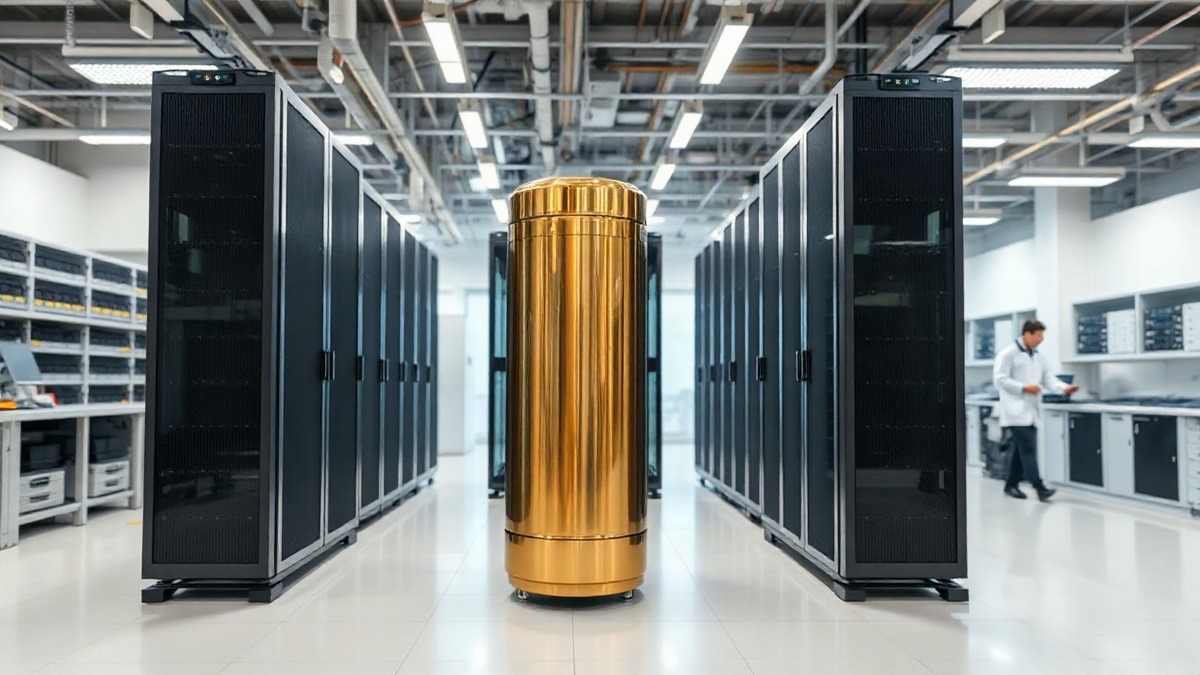

Picture a machine that costs $200 million, weighs 180 tons, and fits inside a Boeing 747. Now picture one company on planet Earth that's the only entity allowed to build it. That company is ASML Holding, and if you've ever used a phone, traded a crypto token, or asked a chatbot a question — you've touched something that came out of its machines.
ASML doesn't make chips. It makes the machines that make chips. Specifically, it makes extreme ultraviolet lithography systems — the only technology capable of printing semiconductors smaller than 5 nanometers. Every NVIDIA H100 that powers a data center. Every Apple M-series processor. Every AMD GPU that game builders depend on. They all go through ASML's tools first. There is no alternative. There is no backup plan. And no competitor is even in the building.
The closest thing to a competitor is Canon, and Canon can't touch leading-edge nodes. Nikon exited the advanced lithography market years ago. This isn't a market with a dominant player — it's a market with the only player.
Let that sink in for a second. The entire global semiconductor supply chain — worth over a trillion dollars in annual revenue across chipmakers, equipment companies, and the software giants running on those chips — depends on one Dutch company with roughly 44,000 employees headquartered in a town called Veldhoven.
The economics of being the only show in town are as good as they sound. ASML's trailing twelve-month revenue sits near $33.7 billion, up over 13% year-over-year. Operating margins run 36%. Free cash flow clocks in above $8 billion. Return on equity is 52%, which for context would make most Fortune 500 companies jealous just reading the number off a screen. And the balance sheet? Net cash of roughly $5.7 billion. This company is not leveraged. It's printing money and stacking it.
What makes the moat genuinely unbreachable is R&D intensity. ASML spends over $4.7 billion annually on research — nearly 15% of revenue — much of it in partnership with Carl Zeiss on the optical systems that focus light with atomic-level precision. A competitor would need to replicate decades of optical engineering, supply chain integration with Zeiss, and manufacturing expertise. The last viable competitor gave up. The next one hasn't been born.
And the demand side just got louder. SK Hynix disclosed plans to spend roughly $8.6 billion on ASML EUV systems for high-bandwidth memory production — the largest single ASML order ever publicly disclosed. Those tools ship through the end of 2027. TSMC reportedly plans to take delivery of 40 or more Low-NA EUV scanners in 2026 alone to equip its Arizona and Taiwan fabs. The total industry target for 2026 is more than 60 EUV tools, with 10 next-generation High-NA units planned for 2027 at roughly $380 million each.
That's a backlog you can build a small country's GDP on. Analysts at Bernstein now project ASML's EUV revenue alone reaches €43 billion by 2030, implying a more than 30% compound annual growth rate from today. The forward price-to-earnings sits around 36x — expensive in isolation, but for a monopoly with earnings growth that direction, the market is arguably still underpricing it.
But it wouldn't be a compelling story without tension. And ASML has two very real clouds hanging over that $700 billion market cap.
First, TSMC — ASML's single largest customer — recently decided not to adopt the High-NA EUV tool for its next-generation A13 manufacturing node. That's the $380 million machine that was supposed to be the next revenue wave. Intel has stepped in as the lead High-NA customer, along with Samsung and SK Hynix, but when your biggest buyer says "maybe later" on your most expensive product, you notice.
Second, Washington is escalating export controls. The proposed MATCH Act would ban not just EUV tools to China — that's old news — but even ASML's mature-node DUV immersion machines. It would also restrict servicing equipment already installed inside Chinese fabs. China accounted for roughly a third of ASML's system sales in 2025. Even optimists peg the hit at 5% of revenue if the legislation passes, but the installed-base service business carries some of the company's highest margins. It's not a demand problem — it's a political risk problem. Different animal entirely.
All of this collides on July 15, when ASML reports second-quarter results. The consensus expects revenue growth to continue accelerating, but the real story will be in the details: order bookings relative to the $38.8 billion backlog at year-end, what management says about China in a post-MATCH-Act world, and whether the High-NA adoption timeline holds or gets pushed further right.
This is the company that makes the pickaxes in the biggest gold rush since the industrial revolution. The moat is permanent. The demand is structural. The question isn't whether ASML wins — it's whether the stock already knows that and has priced it in twice over. Three weeks from now we'll have a much better answer.
Disclosure: The Signal holds no position in ASML. Positions may change. This is not financial advice.