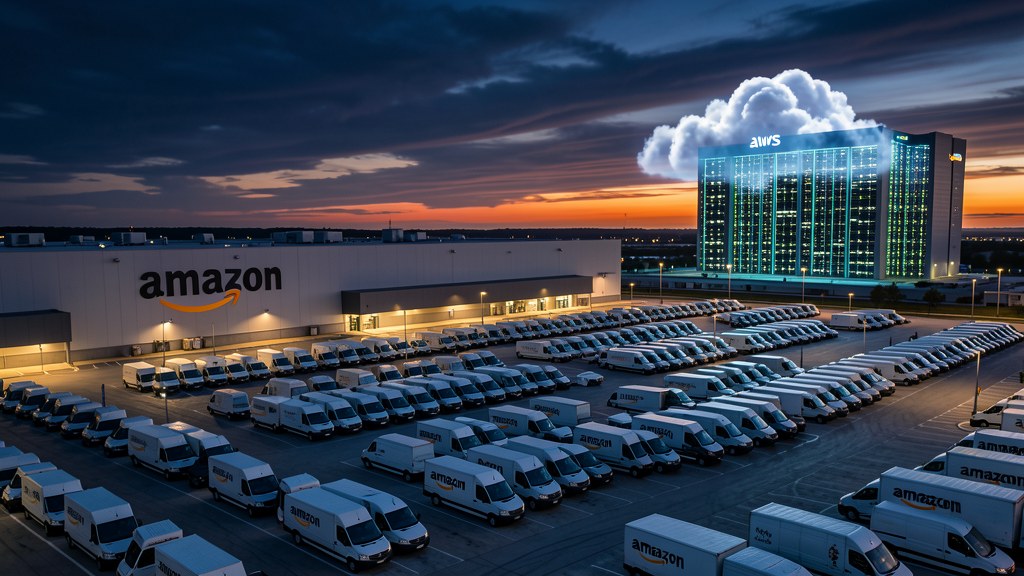
Let's get one thing straight: $AMZN is not a surprise trade. Everyone knows Amazon is big. Everyone knows AWS is the cloud leader. Everyone knows Jeff Bezos's high-school science project turned into the most terrifying retail-and-infrastructure hybrid the world has ever seen.
But here's what isn't priced in: AWS AI cloud revenue is reaccelerating, Andy Jassy just spent $44.2 billion in a single quarter on AI infrastructure, and the market is still treating Amazon like a mature retailer instead of the AI infrastructure juggernaut it's becoming.
At $266.32 with a $2.86 trillion market cap, AMZN is within striking distance of its $278.56 all-time high. YTD return: +17.6%. But 62 analysts say the story is just getting started, with a consensus price target of $312.63 — 17.4% upside from here.
The AWS Reacceleration Nobody's Talking About Enough
Q1 2026 was a flex. Amazon posted $181.5 billion in revenue — up roughly 17% year-over-year — and $30.2 billion in net income. Diluted EPS of $2.78. Operating income of $23.9 billion. These aren't retailer numbers. These are enterprise infrastructure numbers.
The beating heart of this story is AWS. Amazon's cloud division is seeing AI-driven demand reaccelerate at a pace that surprised even the optimists. Enterprise customers are migrating workloads to AWS Bedrock, training LLMs on Amazon SageMaker, and signing multi-year commitments that lock in recurring revenue at scale. The "What's Next with AWS" event in April dropped a wave of new AI services — deeper Anthropic and Meta partnerships, expanded NVIDIA collaboration, and a Fox Corp deal naming AWS as its preferred AI cloud provider.
This is the reacceleration trade. AWS growth bottomed in 2023-2024 as enterprises optimized cloud spend. Now they're building on cloud — and AI workloads are the catalyst that flips the narrative from "optimization" to "expansion."
| Stock Price | $266.32 |
| Market Cap | $2.86 Trillion |
| Revenue (TTM) | $742.8B |
| Revenue Growth | 16.6% YoY |
| Net Income (TTM) | $77.7B |
| Q1 2026 Net Income | $30.2B |
| EPS (Q1 2026) | $2.78 |
| Forward P/E | 27.0x |
| Return on Equity | 24.3% |
| Cash & Equivalents | $101.8B |
| Avg Analyst Target | $312.63 (+17.4%) |
| Analyst Consensus | Strong Buy (62 analysts) |
The $44.2 Billion Quarterly Bet
Here's the number that should make you sit up: $44.2 billion in capital expenditure in Q1 2026 alone. That's more than most companies' annual revenue. It's more than Intel's entire R&D budget for a year. It's Amazon building the AI infrastructure layer for the next decade — data centers, custom AI chips (Trainium, Inferentia), fiber, networking, power.
This spending crushed Amazon's free cash flow to -$18.2 billion for the quarter. But here's the thing: Andy Jassy has been crystal clear that this is intentional. "Amazon investors will be rewarded by all its AI spending" — he told CNBC straight up in early May. When the CEO of a $2.86 trillion company says "trust me, the CapEx pays off," you should at least listen.
Amazon is following the same playbook AWS used from 2014-2020: invest aggressively, build infrastructure before demand materializes, then watch the cash flows compound. The difference? AI demand is arriving faster and at larger scale than cloud adoption did. Amazon's operating cash flow for the trailing twelve months is still $139.5 billion — the company has the firepower to fund this buildout without breaking a sweat.
The Logistics Moat: Prime Gets Tighter
While Wall Street obsesses over AWS AI, don't sleep on what Amazon is doing in logistics. The company now operates the largest last-mile delivery network in the US. Same-day delivery is expanding to more metro areas. Amazon Air is adding capacity. The drone delivery program (Prime Air) is finally scaling beyond pilot programs.
The result: Amazon is compressing delivery times while competitors struggle with margins. In Q1, Amazon's North America segment operating margin expanded to ~6.5% — proof that the logistics buildout isn't just a cost center anymore, it's a competitive moat that generates real profits. The $101.8 billion in cash on the balance sheet gives Amazon the ability to keep investing in warehouses, robotics, and delivery infrastructure while smaller competitors can't keep up.
This is the Amazon flywheel in action: better delivery drives Prime membership growth, which drives marketplace volume, which drives advertising revenue (now a $50B+ annual business), which funds more logistics investment. The flywheel hasn't stopped spinning — it's just gotten faster.
The Valuation Case at 27x Forward Earnings
Here's where it gets interesting for the value-conscious investor. AMZN trades at 27x forward earnings. For a company growing revenue at 16.6% with operating margins expanding, a 31.6x trailing P/E, and a return on equity of 24.3% — that's not expensive. It's fair-to-cheap for a mega-cap with AI tailwinds, logistics defensibility, and advertising acceleration.
Compare AMZN to the other mega-cap AI plays:
- MSFT trades at ~30x forward earnings with slower cloud growth
- GOOGL trades at ~22x forward earnings but lacks Amazon's logistics moat
- NVDA trades at ~35x forward earnings — pure AI play, no retail diversification
AMZN is the only mega-cap that gives you AI infrastructure exposure, a retail/logistics cash cow, and a growing advertising business in a single ticker. That diversification is worth a premium, not a discount — yet AMZN trades in the middle of the pack.
The Analyst Wall of Conviction
Wall Street is unusually unified here. Of 62 analysts covering AMZN:
- 62 Strong Buy/Buy — zero holds, zero sells
- Consensus rating: 1.35 (where 1 is Strong Buy)
- Average target: $312.63 — 17.4% upside
- High target: $370 — 39% upside
- Low target: $207 — but that's the outlier bear case
When the entire analyst community agrees on a mega-cap stock, you have to ask: is it a crowded trade or a consensus that's right? History suggests that for AMZN, the consensus tends to underestimate the upside. Amazon has never traded at or below its consensus analyst target for sustained periods during an AI buildout cycle.
The Risks You Can't Ignore
We're not here to pump the bag. Let's talk about the risks:
CapEx overhang. $44.2B in quarterly CapEx is a staggering number. If AI demand softens — if enterprise customers hit pause on generative AI — Amazon is left holding the world's most expensive data centers. Jassy is betting the company on AI. That bet could blow up.
Regulatory pressure. The FTC is still circling. Anti-trust scrutiny hasn't gone away. A breakup scenario — however unlikely this year — would create massive uncertainty.
Cloud competition. Microsoft Azure is surging on OpenAI integration. Google Cloud is winning AI-native startups. Oracle is carving a database-AI niche. AWS still has 30%+ market share, but the competition is better-funded than ever.
Earnings deceleration. Q1 2026 EPS of $2.78 was strong, but next quarter's estimates (July 30) point to ~$1.81 — a sequential drop driven by heavier CapEx and seasonal retail patterns. If those estimates slip, the stock could correct.
The Bottom Line
Amazon at $2.86 trillion is not a hidden gem. It's the most obvious mega-cap AI infrastructure play in the market — and sometimes the obvious trade is the right one. AWS AI reacceleration, a logistics moat that's printing cash, $101.8 billion in dry powder, and a consensus of 62 analysts screaming Buy.
At 27x forward earnings, you're not paying for peak euphoria. You're paying a reasonable multiple for a company that's building the physical and digital infrastructure of the next economy. Andy Jassy is spending $176 billion a year to make sure Amazon owns that infrastructure. Betting against him has historically been the most expensive mistake in the stock market.
Disclosure: The Signal holds no position in $AMZN. This is not financial advice.